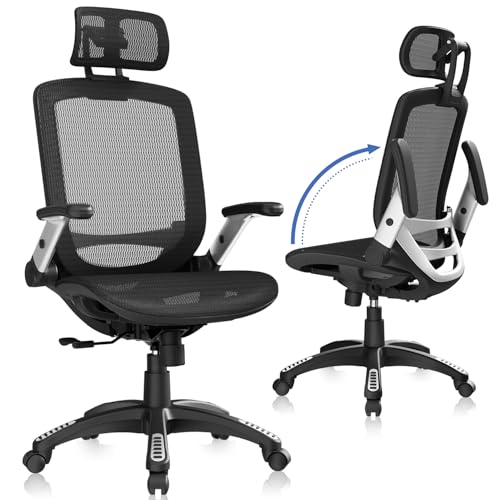
All-mesh high-back chair that sits high and wide — flip-up arms, adjustable headrest, 90–120° tilt lock, mesh seat and back.
Buy if you are a taller sitter (about 5 ft 5 in to 6 ft 2 in) who runs warm and wants mesh airflow on the seat as well as the back — a wide 20 inch seat, flip-up arms that let the chair tuck under the desk, an adjustable headrest, and a roughly seven-hour comfortable window in independent testing.
Skip if you are shorter (testers under 5 ft 4 in could not reach the headrest at its lowest setting), adjustable lumbar support or seat depth is the point — neither exists here — or you need a chair that adjusts to you rather than one you fit as delivered; judge your weight against the conservative 280 lb figure.
Check Price on Amazon →GABRYLLY Ergonomic Office Chair review: an all-mesh high back and seat, flip-up arms, adjustable 3D headrest, 90 to 120 degree tilt lock, wide 20 inch seat pan. That is a chair built on airflow and simplicity rather than adjustment: in TechGearLab's hands-on testing it scored 62 overall with a 7.0 for comfort, three of their testers said they could sit in it for at least seven hours, and the lead tester called it pretty dang comfortable and singled out how it feels when reclining. The honest limits are just as specific, and they are structural: there is no adjustable lumbar support at all — the back's curve gives a fixed, semi level of support the judges split on — the armrests adjust for height only, and the chair sits high, with a measured 17.5 inch minimum seat height and a headrest testers under 5 ft 4 in could not reach even at its lowest setting. Owners on this listing — 14,200+ ratings averaging 4.4 stars (ExpertBeacon's data for this ASIN, updated March 2026) — back the shape of it: a mesh seat and back that stay tight rather than sagging, and a parts-and-support record reviewers praise. Judge it as the tall-sitting, mesh-everywhere chair for upright work and kicked-back breaks — not as the adjustable ergonomic chair its marketing language suggests.
| Seat | Mesh seat, 20 inches wide (measured by TechGearLab) by 19.3 inches deep (listing); no seat-depth adjustment |
|---|---|
| Seat Height | 17.5 to 22 inches, measured by TechGearLab (the listing states 18.5 to 22.05 inches) — among the tallest chairs they have tested at both ends |
| Back | High-back breathable mesh with a curved, fixed lumbar contour — there is NO adjustable lumbar support (TechGearLab's spec table is explicit) |
| Headrest | Adjustable 3D headrest; in testing it suited taller sitters — testers under 5 ft 4 in could not reach it at its lowest setting |
| Armrests | Flip-up arms (45 degrees per the listing; they fold up and back completely out of the way) with height adjustment; no width or pivot adjustment, and they slide forward as they are raised |
| Recline | 90 to 120 degrees with a 3-stage tilt lock and a tilt-tension knob |
| Max Weight | Judge against 280 lb, the lowest published figure (TechGearLab's spec table). Amazon's product information for this ASIN says 300 lb and some listing copy says 400 lb — the figures conflict, so the conservative one governs |
| Dimensions | 25.6 × 22 inches; overall height 45.3 to 54.9 inches (the listing's feature dimensions) |
| Weight | 41 lbs (Amazon product information for this ASIN) |
| Wheels | PU mute wheels on a five-point nylon base |
| Warranty | 3-year (per the listing's current feature list) |
| Assembly | Required; the listing says about 15–20 minutes and TechGearLab took 17 minutes, but found the instructions hard to follow |
| Model | GABRYLLY, manufacturer part number PF-01, Black (this ASIN, B07Y8BXBX8, per Amazon's product information). The Grey listing (B08PBP21RW), the White/Red listing (B0DBTXBB5Q) and the other colourways are different ASINs — do not substitute |
The mesh is the comfort story, and it is mesh everywhere — seat as well as back. TechGearLab's testers appreciated the soft, springy mesh on both surfaces, their lead tester quickly called the chair pretty dang comfortable because of the headrest and the mesh backrest, and three of the panel said they could sit in it for at least seven hours. Owners on this listing say the same thing over a longer clock: roundups of this listing's owner feedback describe mesh that stays tight, a back that does not sag, and a seat that does not bottom out. The airflow is the other half of it — there is no foam anywhere to hold heat, which is why the listing's own copy aims the chair at four-to-eight-hour sitting in warm rooms.
It sits high, and for taller sitters that is the point. TechGearLab measured the seat height at 17.5 to 22 inches — nearly the tallest chair they have tested at both the minimum and the maximum — and the listing recommends the chair for users of about 5 ft 5 in to 6 ft 2 in. The included headrest, a feature testers called premium at this level, was a comfort winner for their taller testers over 5 ft 4 in. If standard chairs leave your knees high and your head unsupported, this one's proportions run the other way.
The flip-up arms earn their place twice over. They fold up and completely out of the way — TechGearLab's unconventional sitters used that to sit criss-cross on the wide 20 inch seat pan, and their ergonomic sitters used it to belly up close to the desk for serious work. In a home office the same move lets the chair push directly under the desk (the listing puts the fold at 45 degrees), which is real floor space back in a small room. Few chairs at this level offer an armrest you can delete in two seconds.
The ownership record behind the listing is unusually deep and unusually serviceable. This ASIN carries 14,200+ ratings at 4.4 stars — the largest owner pool of any chair we review — and reviewers of this listing repeatedly note free replacement parts, upgrade wheels and lumbar pillows sent out without argument. That matters on a chair whose warranty is a modest three years: the documented behaviour of the seller's support is part of what you are buying.
There is no adjustable lumbar support, and no honest reading of this chair can soften that. The listing's marketing says lumbar support, and what it means is the curve of the mesh back: TechGearLab's spec table records adjustable lumbar support as No and the support level as semi — present at all times, minimal, and impossible to increase except by adding your own pillow or to remove if you want less of it. Their judges split on it — some appreciated that it was there, others wanted something more present — and all agreed more control would have made the chair more comfortable. If adjustable lumbar is why you are shopping, this is the wrong chair, full stop.
The rest of the adjustment list is thin in the same way. TechGearLab measured three points of adjustment in total. The armrests adjust for height only — no width, no pivot — and as you raise them they slide forward, which testers found a pain when sitting close to the desk; some also wanted them to go higher. There is no seat-depth adjustment. The tilt-tension knob works, but it sits hard to reach under the wide, deep seat pan and takes quite a few turns before anything changes. None of this stopped the testers finding the chair comfortable — it stopped them calling it truly adjustable.
The mesh seat has a frame, and on long sits you can meet it. Testers found that over hours the hard plastic seat frame can dig into the legs, because the mesh is not firm enough to keep you fully clear of the hardware underneath. Not every judge felt it, but it is the named reason this review does not extend the comfortable window past the roughly seven hours the panel reported — a mesh seat trades the foam seat's pressure for a frame you need the tension to hold you off.
Assembly and the headrest floor finish the list. TechGearLab assembled it in 17 minutes — matching the listing's 15–20 — but were not impressed with the instructions, found some parts heavy and awkward to move, and singled out attaching the headrest as the fiddly step. And that headrest has a floor: testers under 5 ft 4 in could not reach it even at its lowest setting, so shorter buyers are paying for a headline feature they cannot use, on a chair whose minimum seat height is already among the tallest tested.
Day to day, this chair's performance is its test record: an overall 62 from TechGearLab with comfort at 7.0 — the same overall score as the other chair we review, reached by the opposite route. Where the Duramont earns its score with adjustment range on a foam seat, the GABRYLLY earns it with mesh comfort and simplicity: sit down, and the springy seat and back are simply comfortable, with nothing to dial in because there is almost nothing to dial. Three testers put its comfortable window at seven hours or more, and the recline is the feature the lead tester kept returning to — she liked how the chair feels tilted back enough to say she could nap in it, inside a 90 to 120 degree range with three lock points.
The upright half of its range is the work half. Testers describe a chair that suits an upright posture for serious work, then kicks back for mousing through tasks — the two postures a remote-work day actually alternates between. The flip-up arms support both: down for typing support, up and away for close-to-desk or crossed-leg sitting, which the 20 inch seat pan has genuine room for.
Owners running the chair for months report the mesh holding its tension — back not sagging, seat not bottoming out — which is the long-clock version of the testers' first impression, and the failure reports that do surface are met by the parts-replacement behaviour noted above rather than by silence. The honest ceiling stays where testing put it: comfortable for extended sitting, short of the adjustability a truly all-day, every-day chair needs.
Taller remote workers — the listing's own range is about 5 ft 5 in to 6 ft 2 in, and testing gives the chair an edge to taller sitters — who run warm, sit upright for work and kick back for breaks, and want mesh airflow on the seat as well as the back. It is especially relevant if your desk is in a small room: the flip-up arms let the chair tuck under the desk, and the wide seat suits crossed-leg and one-leg-up sitters that a narrow task chair fights.
Skip it if you are shorter — testers under 5 ft 4 in could not reach the headrest at its lowest setting, and the 17.5 inch minimum seat height measured in testing is among the tallest there is. Skip it if adjustable lumbar support or seat depth is the point of the purchase: neither exists here, and our Duramont Ergonomic Office Chair review covers the chair whose lumbar does move (in four directions, if a small amount) on a foam seat, with a 330 lb rating, for larger frames. Skip it if you sit all day every day and need a chair that adjusts to you rather than one you fit as delivered — independent testing is blunt that more adjustability is available a step up. And judge your weight against 280 lb, the lowest of this listing's conflicting published capacity figures, not the largest.
A chair is the foundation layer of a desk setup — the layer our ergonomic desk setup guide builds the screen, surface, feet and light layers on top of — so set its height against your desk before judging any other part of your setup.
This chair carries three fit facts, and they matter more than any feature on it: it sits high (a measured 17.5 inch minimum seat height), its headrest only reaches down so far (testers under 5 ft 4 in could not use it), and its comfortable window in testing was about seven hours. Everything else about fit follows from those three, so check them against your own body and your own workday — your height, and how many hours a day the chair actually holds you — before anything else on this page matters.
Height is the first check because so little on this chair adapts. The listing recommends users of about 5 ft 5 in to 6 ft 2 in, and testing agrees with the shape of that range while sharpening its lower edge: shorter testers could still keep their feet on the floor, but the headrest — the feature that should reward a tall back — was out of reach below 5 ft 4 in. The weight check needs care rather than a single number: this listing's capacity is published as 280 lb in TechGearLab's spec table, 300 lb in Amazon's product information, and 400 lb in some listing copy. We publish and advise the lowest figure; a buyer between 280 and 300 lb is in contested territory, and a buyer over 300 lb is outside every figure except the stray one.
| Taller user, about 5 ft 5 in to 6 ft 2 in | Fits — the reason to buy | The listing's own recommended range; testers found the high seat range and the headrest both suit taller sitters. |
| User under 5 ft 4 in | Poor fit | Testers that height could not reach the headrest at its lowest setting, and the measured 17.5 inch minimum seat height is among the tallest tested. |
| Sitting up to about seven hours a day | Fits | Three of TechGearLab's testers said they could sit in it at least seven hours; the mesh seat and back stay comfortable and cool. |
| Sitting eight-plus hours a day, every day | Stretch | Independent testing steers all-day, every-day sitters to chairs with more adjustability — this one has three measured points and no adjustable lumbar. |
| Crossed-leg or one-leg-up sitter | Fits | The 20 inch seat pan has room for it, the mesh does not dig in, and the arms fold completely out of the way. |
| Small room, chair must tuck under the desk | Fits | Flip the arms up (45 degrees per the listing) and the chair pushes directly under the desk. |
| User up to 280 lb | Fits, check the ceiling | Judge against 280 lb — the lowest of this listing's three conflicting published capacity figures. |
| User over 300 lb | Outside the rating | Above every published figure except one stray 400 lb listing bullet. The fix is a chair rated for the load — the Duramont we review is rated 330 lb. |
Our chair coverage now holds two high-back chairs, and they reach the same overall test score by opposite routes. The Duramont is the adjustment chair: a foam seat, a lumbar support that moves up, down, in and out (a small range, but a real one), a tilt tension knob testers praised, and a fit geared to larger frames at a 330 lb rating — capped by testing at four to five comfortable hours and a headrest its judges called uncomfortable. The GABRYLLY is the simplicity chair: mesh on the seat as well as the back, a fixed curved lumbar contour with no adjustment at all, flip-up arms the Duramont cannot match, and a comfortable window testers put at about seven hours — on a chair that sits higher and fits taller rather than larger.
So the choice runs on two questions. First, the seat: if you run warm or sit crossed-legged, the GABRYLLY's all-mesh seat is the answer, and if you want a cushioned seat with a moving lumbar behind it, the Duramont is. Second, the frame: larger and heavier points to the Duramont's 330 lb rating, taller and longer-legged points to the GABRYLLY's 17.5 to 22 inch seat range and reachable headrest. Neither is the all-day premium chair — testing caps both below that tier — but they are the two honest shapes of this level, and the owner pools behind both (14,200+ ratings at 4.4 stars for the GABRYLLY, 7,000+ at 4.1 for the Duramont, both as of March 2026) say each shape has its buyers.
| Seat | Mesh, 20 in wide | Foam cushion (listing describes it as memory foam) |
| Lumbar support | Fixed curved contour — no adjustment | Adjustable up/down/in/out, small range |
| Armrests | Flip-up, height only | Height; fore-aft only by loosening screws (about 1 in) |
| Comfortable window (testing) | About 7 hours | 4 to 5 hours |
| Weight rating | 280 lb (conservative; sources conflict to 300/400 lb) | 330 lb |
| Warranty | 3-year (listing) | 5-year (listing) |
| Owner pool | 14,200+ ratings, 4.4 stars (Mar 2026) | 7,000+ ratings, 4.1 stars (Mar 2026) |
No. The lumbar support is the fixed curve of the mesh back — TechGearLab's spec table records adjustable lumbar support as No and the support level as semi. It is present at all times and cannot be increased except by adding your own pillow, or removed if you want less. The Duramont Ergonomic Office Chair we also review is the one whose lumbar moves.
The published figures conflict: 280 lb in TechGearLab's spec table, 300 lb in Amazon's product information for this ASIN, and 400 lb in some listing copy. We publish and advise the conservative 280 lb figure. Buyers over 300 lb are outside every figure except the stray 400 lb bullet and should choose a chair rated for the load.
It is a taller user's chair. The listing recommends about 5 ft 5 in to 6 ft 2 in; TechGearLab measured a 17.5 to 22 inch seat height, among the tallest they have tested, and found the headrest a comfort winner for testers over 5 ft 4 in — while testers under 5 ft 4 in could not reach the headrest even at its lowest setting.
About seven hours in TechGearLab's testing — three testers said they could sit in it at least that long, and its comfort score was 7.0. The same testing is blunt that it lacks the adjustability a truly all-day, every-day chair needs, and that on very long sits the seat's hard plastic frame can be felt through the mesh.
Yes — they fold up and completely out of the way (the listing puts the fold at 45 degrees), which lets the chair push directly under a desk and lets you sit crossed-legged on the 20 inch seat pan. Height is their only other adjustment: no width or pivot, and they slide forward as they are raised.
TechGearLab took 17 minutes, in line with the listing's 15–20 minutes, but found the instructions hard to follow, some parts heavy to move, and attaching the headrest the awkward step. The listing's current feature list states a 3-year warranty, and reviewers of this listing repeatedly note replacement parts being sent without argument.
The GABRYLLY Ergonomic Office Chair is a comfort-first, adjustment-light chair: an all-mesh seat and back that testers and a 14,200+ owner pool both call genuinely comfortable, a high 17.5 to 22 inch seat range and headrest that suit taller sitters, flip-up arms that serve both close desk work and small rooms, and a roughly seven-hour comfortable window in independent testing. What it does not have is adjustment where ergonomic marketing implies it — no adjustable lumbar, no seat-depth control, height-only armrests — and its published capacity figures conflict, so the conservative 280 lb governs. Buy it as the tall, airy, simple chair it demonstrably is; buy the Duramont instead if moving lumbar support and a higher rating matter more than mesh.