
Buying Guide — Standing Desks
Best Standing Desk for Small Spaces
The short answer first: in a small room, the desk is rarely the hard part — the room around it is. Both electric desks we've reviewed at the small size share one footprint, 48 by 24 inches, and split on everything else: one arrives as a complete box with a lower load limit, the other offers a seamless top and nearly two-thirds more capacity. Here's the room math to run before either of them, then how the choice between them actually breaks.
Affiliate disclosure: Home Office Stack is a participant in the Amazon Services LLC Associates Program. As an Amazon Associate, we earn from qualifying purchases made through links on this page — at no extra cost to you. Picks are research-based, grounded in manufacturer specs and published owner feedback; we don't accept sponsored placements.
Do the room math before the desk math
The top is 8 square feet; the workstation is not. A 48 by 24 inch desktop covers about 8 square feet of floor. What it needs is roughly double that once you count the person: room guides put chair clearance at about 24 to 36 inches behind a desk — enough to roll back, swivel, and stand up — with a little more at standing height, where you step back from the surface instead of pushing a chair away. Budget about 48 to 60 inches of total depth, wall to the nearest bed, shelf, or second desk, before you fall for any top.
Tape it, then live with the tape for a day. Mark the 48 by 24 inch footprint on the floor with painter's tape, put your chair inside the outline's clearance zone, and walk the room's normal paths. A fit that only works when the door is closed, the wardrobe stays shut, or the chair is parked sideways is not a fit — it is a daily negotiation you will lose by week two.
Check the two things listings never mention: the outlet and the rise. An electric desk needs power where it stands, and its cables need slack through the full height range, not just at sitting height. Then look up: at maximum height the desktop plus a monitor on top of it needs clear vertical room, so a low shelf or a sloped ceiling over the taped outline can cap a desk whose floor fit is perfect.
The desks we've reviewed, compared
| SHW 48-Inch Electric Standing Desk | The complete box — drawer, cable tray, grommet and hooks included | 48 × 24 in · 28–45 in range · 4 presets | 110 lb limit, per its manual |
| FLEXISPOT EN1 One-Piece Standing Desk | The seamless top — one solid piece, no splice joint, and the higher rating | 48 × 24 in · 28.9–46.5 in range incl. top · 4 presets | 176 lb limit · no drawer or cable tray included |
| VIVO Electric 63 x 32 Inch Standing Desk | The contrast — the desk to want when the small brief itself is wrong | 63.1 × 31.5 in · 25.3–51 in range · 3 presets + timer | 176 lb on the desktop, per its manual |
Specs above are the manufacturers' figures as recorded in each product's full review on this site. Read the first two rows honestly: the footprint, the presets, and even the height ranges are close. What actually separates the two small desks is load (110 lb against 176 lb), what is in the box (everything against almost nothing), and the surface itself (a laminated top with a drawer under it against one seamless piece). The third row is there to be ruled out — or to catch the cases where ruling it out is the mistake.
For a light setup that should arrive complete: SHW 48-Inch

The SHW is the pick when the setup is light and the room has nowhere to store the extras. Its 48 by 24 inch Walnut top sits on a 28 to 45 inch electric range with four memory presets, and the box carries the rest of a small-room setup with it: an under-desk drawer with adjustable compartments, a cable tray, a desktop grommet, cable clamps, and two utility hooks. In a bedroom or a small study, that included kit is not a bonus list — it is storage and cable control you do not have to find floor or wall space for separately, which is exactly the resource a small room is short of.
Fit check: the limit is printed in its own manual — 110 lb on the desktop, full stop. A laptop and one monitor, or two modest monitors on their own stands, sit inside it comfortably; a tower PC on the top plus a heavy dual-monitor arm is the classic case that runs past it. The 28 inch floor is the second gate: it is high for a shorter seated user, and no preset fixes a range that does not reach your elbows.
For a heavier setup on the same footprint: FLEXISPOT EN1
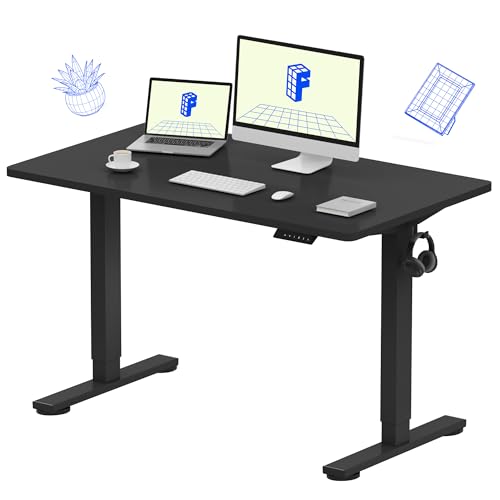
The EN1 is the pick when the same 48 inches have to carry more. Its desktop is a single 1-inch-thick piece — no centre seam to catch a wrist, split under a monitor-arm clamp, or ripple at standing height — on a 28.9 to 46.5 inch range (including the top) with four presets, a single motor its manual rates under 50 dB, and a 176 lb weight limit. That capacity gap is the real fork between these two desks: two monitors on an arm, a desktop PC on the top, and speakers stop being a load calculation you have to keep re-doing.
Fit check: the complete box is not the point here — the box is a desk and a headphone hook, with no drawer and no cable tray included, so a small room still owes those a home as second purchases; our cable management guide covers the formats that can supply the tray's job. The 28.9 inch minimum is slightly higher than the SHW's, the control panel mounts on the right side only, and reviewers who leaned on it at full height found the slight sway every two-leg frame has.
When the small desk is the wrong answer
Both 48-inch desks share one blind spot, and it is at the ends of the body, not the ends of the room. Neither goes below 28 inches, so a shorter seated user whose elbows land well under that gets a desk that cannot come down to them; neither tops out past 46.5 inches, so a taller standing user runs out of range at the other end. The wider VIVO 63 x 32 is the only desk we review that covers both ends — 25.3 to 51 inches — on a curved 63.1 by 31.5 inch top rated to the same 176 lb. If your body needs that range, or your layout is genuinely two large monitors plus a laptop, giving a small room the bigger desk and taking the space back elsewhere is the honest trade. Its own costs are recorded in its review: a three-piece top whose seams some owners feel under the mouse, and a two-carton assembly that wants a second pair of hands.
And if your wall is under 48 inches, neither small desk here is a buy at all. Desks under this size are different listings with their own ranges and limits; shop that class on its own figures rather than treating a 48-inch top as something a tight wall can be talked into.
Small-space standing desk questions, answered honestly
Is a 48 by 24 inch desk big enough?
For a laptop plus one monitor, or one large monitor on its own, yes — that is the layout this size is built for, and it is the standard small home-office footprint. Two large monitors plus a laptop open beside them is where 48 inches runs out: the panels fit only angled in, with no writing room left. That layout wants the next size class up, not a wider arrangement squeezed onto a 48-inch top.
How much room do I need behind a small standing desk?
More than the desk itself takes. The top is 24 inches deep, but a chair needs roughly 24 to 36 inches behind it to roll back, swivel and stand up — more at standing height, where you step back from the surface. Plan on about 48 to 60 inches of total depth from the wall to the nearest furniture behind you, tape the footprint on the floor first, and check the door swing and the nearest outlet before ordering.
Are the 48-inch desks too high for a shorter seated user?
They can be, and it is the small-desk trap nobody prints on the box. Both reviewed 48-inch desks start high — 28 inches for the SHW and 28.9 inches including the top for the FLEXISPOT EN1. If your seated elbow height lands well below that, the desk cannot come down to you: the honest fixes are a footrest under your feet or a desk with a lower minimum. The wider VIVO we review starts at 25.3 inches, which is one of the few reasons to give a small room a bigger desk.
Can a 48-inch standing desk hold two monitors?
Count the load, not just the width. Two modest monitors on their own stands sit comfortably inside the SHW's 110 lb manual limit. A dual-monitor arm, a tower PC on the desktop and speakers push the total up fast — that is the setup the FLEXISPOT EN1's 176 lb rating exists for, on the same 48 by 24 inch footprint. Load the desk to the manual's figure, not a listing headline.
What if my wall is shorter than 48 inches?
Then neither desk in this guide is the right buy. A 48-inch top needs its 48 inches plus a little working clearance at each end, and forcing it against a return wall or a door swing trades a desk problem for a room problem. Desks under 48 inches exist as different listings with their own ranges and limits — measure the wall first and shop that size class on its own figures, not as a stretch of these.
Bottom Line
Measure the room, then split on load and the box
Tape the footprint, count 48 to 60 inches of total depth, and check the outlet and the rise first — a small room rejects more desks than any spec sheet does. Inside the fit, the choice is plain: a light-to-medium setup that should arrive complete points to the SHW 48-Inch; a heavier setup, or a forearm that lives on the surface, points to the seamless, higher-rated FLEXISPOT EN1. A body outside either desk's range is the one case for the larger VIVO 63 x 32. For where a desk sits in the whole setup, see our ergonomic desk setup guide — or, for the full room, our small home office setup guide, which builds the screen, input and cables around this same 48-inch footprint — or browse all our standing desk reviews.