
Buying Guide — Chairs
Best Ergonomic Office Chair for Working From Home
The short answer first: a chair is a fit product before it is a features product. Seat depth and back height are built in — no knob changes them — so the frame you fit decides the shortlist, and only then do lumbar type, seat material and sitting hours separate the survivors. The four ergonomic chairs we've reviewed split exactly that way: one is sized for larger frames, one is the all-mesh chair that sits high and wide, one is the adjustable task chair that fits the widest range of bodies by moving its seat instead, and one is the full-mesh chair sized for smaller frames whose lumbar support moves furthest. Here's how to tell which frame is yours.
Affiliate disclosure: Home Office Stack is a participant in the Amazon Services LLC Associates Program. As an Amazon Associate, we earn from qualifying purchases made through links on this page — at no extra cost to you. Picks are research-based, grounded in manufacturer specs and published owner feedback; we don't accept sponsored placements.
Run the frame, lumbar and hours checks before the features check
Frame first, because it cannot be adjusted away. Two numbers do most of the deciding: seat depth against the back of your thighs, and back height against your shoulders. A seat that is too deep forces you to perch or slouch no matter how good the lumbar is, and a back that ends mid-shoulder is a different chair from one that reaches your head. Of the four below, only one lets you change its seat depth after delivery — that single fact is why fit, not the adjustment count, leads this guide.
Lumbar second, because the four chairs mean four different things by it. A lumbar pad you can move in height and depth, a moving panel you can place where your back actually curves, a small-range pad that nudges, and a fixed contour moulded into a mesh back are not four grades of the same feature — they are four different bets. If a fixed shape has already failed your back, only the first bet is new information; if you have never thought about your lumbar, the fixed contour may never give you a reason to.
Hours third, because every chair here has an honest ceiling. The testing behind our reviews puts a comfortable window on each chair, and none of the windows is an unbroken eight-plus-hour day. That is not a defect to hide — it is the line between this tier and premium chairs — but it means the right question is not "which is best" but "which window matches how I actually sit: in blocks, in a moderate day, or close to a full one with breaks." Match the window and the frame, and the features list mostly reads itself.
The chairs we've reviewed, compared
| Duramont Ergonomic Office Chair | The larger-frame pick — high-back mesh back, foam seat, headrest | Rated to 330 lb · back interior height 21.25 in · adjustable lumbar (small range) | Rollerblade-style casters · 5-year warranty per the listing |
| GABRYLLY Ergonomic Office Chair | The all-mesh pick — mesh seat and back, sits high and wide | Seat 20 in wide · seat height 17.5–22 in measured · no adjustable lumbar | Flip-up arms · 90–120° tilt lock · judge weight against 280 lb |
| HON Ignition 2.0 Mid Back Task Chair | The adjustable pick — mid-back task chair with a seat-depth slide | Seat depth slides 16.25–19.25 in · seat height 17–21 in · rated to 300 lb | Moving lumbar panel · synchro-tilt · HON Limited Lifetime Warranty |
| SIHOO M57 Ergonomic Office Chair | The dial-in mesh pick — full-mesh seat and split back, sized for small-to-average frames | Lumbar adjusts in height and depth · seat depth fixed at 18.11 in · rated to 330 lb | 3D armrests · adjustable headrest · aluminum base · 3-year warranty |
Specs above are the manufacturers' figures as recorded in each chair's full review on this site — including the GABRYLLY's weight rating, where published figures conflict (300 lb in Amazon's product information, 400 lb in some listing copy) and our review judges against the lowest published figure, 280 lb from independent testing's spec table. Read the table by the checks, not by the longest feature list: the split that matters is a fixed deep seat against a sliding one, a moving lumbar against a fixed contour, and foam against mesh under you.
For taller and larger frames: Duramont Ergonomic Office Chair

The Duramont is the pick when smaller chairs are the problem you are solving. It is a genuinely tall chair — a 21.25-inch back interior height plus an integrated adjustable headrest — rated to 330 lb, tied for the highest figure of the four, and in the independent hands-on testing our review is grounded in, the taller testers were the happy ones: they liked the deeper seat and the full backrest, and found the support real when you sit back in it properly. The back is breathable mesh over a thick foam seat cushion, the lumbar moves up, down, in and out, tilt has a tension knob and a limiter with three recline positions, and the rollerblade-style wheels are the other owner favourite in the feedback — they glide smoothly and quietly compared with standard casters. Owners on the listing consistently call the build sturdy, and the listing carries a 5-year warranty.
Fit check: the same dimensions that fit larger frames exclude smaller ones — shorter testers struggled with the fixed deep seat, there is no seat-depth adjustment to shorten it, and the lumbar's range is small in testing despite its four directions of travel. The headrest divided testers, armrest fore-aft movement is about an inch and only by loosening screws, and the testers' honest window is a few hours to a moderate day rather than an eight-hour one. Judge it as exactly what it is: the larger-frame, part-to-moderate-day chair.
For warm sitters who want mesh under them too: GABRYLLY Ergonomic Office Chair
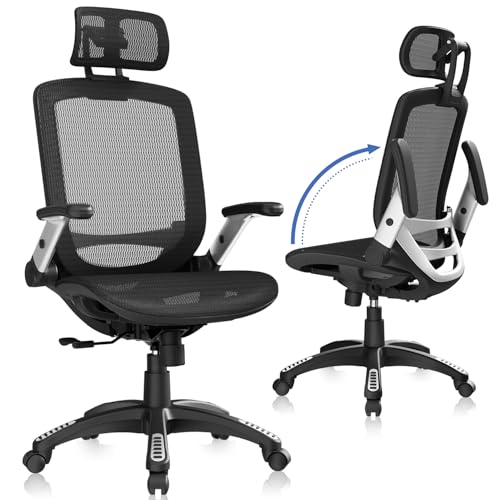
The GABRYLLY is the pick when airflow is the brief. It is one of two chairs here with a mesh seat as well as a mesh back — the taller-sitting one — so nothing under you traps heat the way a foam cushion does — and it cannot flatten the way foam can. The seat is wide, measured at 20 inches, the chair sits high (seat height measured at 17.5 to 22 inches, among the tallest its testers had measured at both ends), and its flip-up arms fold completely out of the way so the chair tucks under the desk and you can sit cross-legged or sideways without armrests dictating posture. Tilt locks across 90 to 120 degrees in three stages with a tension knob, the 3D headrest adjusts, and independent testing puts its comfortable window at roughly seven hours — a long window for this tier.
Fit check: there is no adjustable lumbar support here at all — the back carries a fixed curved contour, explicit in the testing's spec table — and no seat-depth adjustment behind the 19.3-inch-deep seat. The headrest suits taller sitters: testers under 5 ft 4 in could not reach it at its lowest setting. And judge your weight against 280 lb, the lowest published figure, because the sources conflict (Amazon's product information says 300 lb and some listing copy says 400 lb). Buy it if you fit it as delivered; it adjusts to you the least of the four.
For the widest fit range and shared desks: HON Ignition 2.0

The HON Ignition 2.0 — the Advanced Synchro-Tilt configuration our review covers — is the pick when the chair has to fit a body the others cannot be adjusted to, or two different bodies on a shared desk. It is the only one with a seat-depth slide, adjusting depth across 16.25 to 19.25 inches in the manual's diagram, and its lumbar panel moves up and down over a wide range testers described as reaching almost any height and found genuinely effective. Seat height runs 17 to 21 inches, the rating is 300 lb, the arms adjust in height and width, and the synchro-tilt carries tension control and a lock. It is a mid-back in 4-way stretch mesh over a contoured foam seat, it assembled in eight minutes in testing — the fastest chair its testers had built — and it carries the HON Limited Lifetime Warranty, the longest coverage here by a distance.
Fit check: mid-back means no headrest on this configuration (an optional headrest exists elsewhere in the Ignition line, but it is not this listing), the lumbar panel is thin, unpadded plastic rather than a soft pad, and testing caps its comfortable window at about six hours, with the foam seat flattening on prolonged sits. Its printed instructions are also outdated per its testers, listing steps current models no longer need — a confusing page inside an otherwise eight-minute build. Buy it for adjustment range and warranty, in sitting blocks, not for all-day plushness.
For smaller frames who want the lumbar to move furthest: SIHOO M57

The SIHOO M57 is the pick when a fixed lumbar curve has never landed in the right place on your back. Its lumbar support adjusts in height and depth — both directions, per the model's manual, and more travel than any other chair here — the headrest lifts about 3.15 inches and tilts to 45 degrees, the 3D armrests move in height, fore-aft and angle, and the recline locks at three positions between 90 and 126 degrees. It is full mesh — seat as well as split back, with a waterfall front edge — on a reinforced aluminum base rated to 330 lb, and reviewers who write six to eight hours a day in it credit exactly that airflow and seat edge, with owners reporting the mesh holding its tension over months rather than sagging.
Fit check: the fit runs smaller than the marketing — despite the big-and-tall listing language, sitters around six feet and up regularly find the headrest and armrests running out of range, so this is a small-to-average-frame chair. The mesh starts taut and firm and needs about a week to break in, the lumbar can feel forward-pushy until the depth adjustment dials it out, the seat depth is fixed at 18.11 inches with no slider, and the armrests are the weak part twice over: thin pads that feel hard on elbows, and the component owners report failing first — balanced by a support record that includes replacement arms sent free to a four-year owner outside the 3-year warranty. Buy it to dial a chair in for one smaller sitter, not to fit a tall one.
When none of these four is the right buy
If you sit eight-plus hours a day, every day, the testing behind all four reviews points the same way: this tier tops out below that job, and a premium chair is the honest recommendation — no adjustment list on this page turns a budget-to-midrange chair into an all-day premium one. The same honesty applies to pain: a chair can remove a fit problem (a seat digging into your thighs, a back ending mid-shoulder), but persistent back or joint pain is not a gear specification, and it deserves a clinician before it deserves a checkout.
And if your current chair actually fits — feet supported, a small gap behind your knees, back supported through a normal day — the right buy may be no buy, or a smaller one: our ergonomic desk setup guide treats the chair as one layer of four, and the layer that is actually wrong is often the screen height or the surface, not the seat.
Chair questions, answered honestly
Which ergonomic office chair fits a taller or larger frame?
Of the four chairs we review, the Duramont is the one sized for larger frames: a high back with a 21.25-inch interior height, an integrated headrest, and a 330 lb rating — and in independent testing the taller testers were the happy ones. The GABRYLLY also suits taller sitters, roughly 5 ft 5 in to 6 ft 2 in by its review's fit notes, with a seat that sits high at both ends of its range. The HON Ignition 2.0 is the mid-back of the four, so a tall sitter who wants back and head support above the shoulders should look at the high-backs first. The SIHOO M57 is the one to avoid here: despite its big-and-tall listing language and the same 330 lb rating, sitters around six feet and up regularly find its headrest and armrests running out of range.
Do I need adjustable lumbar support in an office chair?
Only if a fixed back shape has already failed you. The four chairs split four ways: the SIHOO M57's lumbar moves in height and depth — the most travel of the four, per its manual — though it can feel forward-pushy until the depth is dialled out; the HON Ignition 2.0's lumbar panel moves up and down over a wide range testers found genuinely effective, though the panel itself is thin, unpadded plastic; the Duramont's lumbar moves up, down, in and out but only over a small range in testing; and the GABRYLLY has no adjustable lumbar at all — just a fixed curved contour in the mesh. If lumbar position is the specific problem you are solving, that order matters more than any other feature on this page.
Is a mesh seat better than a foam seat?
It is a trade, not an upgrade. Two of the four have mesh seats: the GABRYLLY's mesh seat is the airflow pick for taller sitters — it runs cooler than foam and cannot flatten the way foam can — and the SIHOO M57's full-mesh seat adds a waterfall front edge and holds its tension over months, but it starts taut and firm and needs about a week to break in. Foam runs the other way: the Duramont's thick cushion starts firm and softens with use, and the HON's contoured foam starts supportive but can flatten on prolonged sits in testing. Warm sitters who move often tend to prefer mesh; sitters who want a padded feel for long still blocks tend to prefer foam, with the flattening caveat priced in.
How long can I comfortably sit in these chairs each day?
Honestly, none of the four is an eight-plus-hour, every-day chair in the testing behind our reviews — that is the premium tier's job, and each review says so. The GABRYLLY's comfortable window in independent testing is roughly seven hours, the HON Ignition 2.0's is about six hours, and the Duramont is rated by its testers as a decent chair for a few hours to a moderate day, with taller testers happiest on full days. The SIHOO M57's long-session evidence is its reviewers writing six to eight hours a day in it and crediting the airflow and waterfall seat edge — after its break-in week, and in a firm mesh sit, never a soft one. If you sit forty-plus hours a week unbroken, treat these as the honest budget-to-midrange answer and a premium chair as the real one.
Which of these chairs fits a shorter sitter?
Start with the HON Ignition 2.0 or the SIHOO M57, for different reasons. The HON is the only one of the four with a seat-depth slide (16.25 to 19.25 inches in the manual's diagram), so its seat can be made shallower, and its seat height starts lowest, at 17 inches. The SIHOO M57 is sized best for small-to-average frames — its headrest, armrest and lumbar ranges are built for that frame — but its seat depth is fixed at 18.11 inches, so check that depth against your thighs first. The other two carry recorded shorter-sitter warnings: the Duramont's fixed deep seat and tall back struggled with shorter testers, and on the GABRYLLY testers under 5 ft 4 in could not reach the headrest at its lowest setting, while its measured seat height starts at 17.5 inches — among the tallest chairs its testers had measured. A deep, fixed seat is the fit failure no adjustment can undo.
Bottom Line
Check frame, lumbar and hours — then pick
Name the frame you fit, the lumbar bet you need, and the sitting window you actually keep, and buy the chair that matches all three: larger frames and a headrest point to the Duramont; warm, high, wide all-mesh sitting points to the GABRYLLY; the widest adjustment range, a shared desk and the lifetime warranty point to the HON Ignition 2.0; and a smaller frame that wants the lumbar itself to move — in height and depth, over full mesh — points to the SIHOO M57. For where a chair sits in the whole setup, see our ergonomic desk setup guide, or browse all our chair reviews.