
Buying Guide — Chairs
Best Ergonomic Chair for Petite & Smaller Users
The short answer first: a smaller user's chair choice is decided by three measurements, not by an "ergonomic" label — how low the seat goes, how shallow the seat pan is, and whether the lumbar support can come down to a smaller back. Of the four chairs we've reviewed, one is the chair reviewers conclude fits small-to-average frames, one owns the lowest seat and the only depth slide that goes genuinely shallow, and two overshoot smaller frames on exactly these measurements. Here are the checks to run, then how the four split.
Affiliate disclosure: Home Office Stack is a participant in the Amazon Services LLC Associates Program. As an Amazon Associate, we earn from qualifying purchases made through links on this page — at no extra cost to you. Picks are research-based, grounded in manufacturer specs and published owner feedback; we don't accept sponsored placements.
Three measurements decide it, not your height
"Suitable for all body types" is a claim about nobody in particular. Two people of exactly the same height can fit a chair completely differently, because what meets the chair is not height — it is leg length against the seat, torso length against the back, and back size against the lumbar support. The four chairs below all sit in the same ergonomic class; their published measurements tell four different stories, and two of those stories run in the larger direction. Shop the measurements.
First check: the bottom of the seat-height range. Sit with your feet flat on the floor. If a chair's seat bottoms out above the height where that happens for you, your feet dangle, the seat front presses under your thighs, and you slide forward toward the floor — out of whatever back support the chair offers. The low end is the figure a smaller buyer is shopping for, and it is the figure listings headline least: of our four, the lowest floor is 17 inches, and one chair starts a half-inch above it at both ends of its range. One honest gap, carried from our tall-users guide: our Duramont review records its overall dimensions but no seat-height range, so for that chair the listing's figure is a check you have to run yourself — we flag it again in its section rather than guess a number.
Second check: seat depth. Shorter legs need a shallower pan; too deep and the front edge presses behind your knees, so you either perch on the edge without back support or slouch down into the seat to reach the backrest. Depth is also the least adjustable dimension in this class — only one of the four chairs slides, and where its slide stops at the shallow end is the single most useful number in this guide. Third check: lumbar and headrest low-end reach. Support helps only where it can arrive: a lumbar panel that cannot come down far enough lands above the small of a smaller back, and a headrest that starts too high is decoration. One chair here adjusts its lumbar in two directions; another's headrest is reported unreachable by testers under 5 ft 4 in even at its lowest setting. Both facts are in the reviews — they are the difference between adjustability on a spec sheet and adjustability that reaches you.
The chairs we've reviewed, compared by smaller-frame fit
| SIHOO M57 Ergonomic Office Chair | The smaller-frame pick — the chair reviewers conclude fits small-to-average frames | Seat height from about 17.1 in with about 4 in of travel · seat depth fixed at 18.11 in · lumbar adjusts in height and depth | 330 lb rating — capacity is not its story; fit is |
| HON Ignition 2.0 Mid Back Task Chair | The short-leg pick — lowest seat we review, and the only seat-depth slide | Seat height 17–21 in · seat depth slides 16.25–19.25 in · mid-back, no headrest in this configuration | 300 lb rating · HON Limited Lifetime Warranty |
| GABRYLLY Ergonomic Office Chair | The honest skip for smaller sitters — sized for taller frames at both ends | Seat height 17.5–22 in (measured) · seat 20 in wide × 19.3 in deep, fixed · headrest unreachable under 5 ft 4 in at its lowest | Judge against 280 lb — the lowest published figure |
| Duramont Ergonomic Office Chair | The larger-frame skip — deep seat and tall back, with one figure to verify first | Back interior height 21.25 in · 26 × 23.6 × 42 in overall · seat-height range not recorded in our review | 330 lb rating |
Specs above are the figures as recorded in each product's full review on this site, including where a review publishes a measured figure alongside a listing figure. Read the table's honest shape: this is a two-chair answer for most smaller readers — the SIHOO when frame fit and lumbar travel decide it, the HON when leg length and seat depth do — and two chairs that belong in this guide as warnings against assuming an ergonomic label means a chair sizes down.
The smaller-frame pick: SIHOO M57

The M57 leads this guide because the evidence in its review points at smaller frames directly. Hands-on reviewers conclude it fits small-to-average frames best — the same finding that makes it the honest skip in our tall-users guide — and its seat starts at about 17.1 inches per the model's manual, with about 4 inches of travel measured by reviewers. That is not the lowest floor in this comparison, but it sits within a tenth of an inch of it, on the chair whose whole fit runs smallest.
The adjustment underneath is what makes the fit usable rather than merely small. The M57's lumbar support adjusts in height and in depth — the model's manual is explicit on both directions — so it can be brought down to the small of a smaller back and set to a depth that supports without pushing. Its seat is a fixed 18.11 inches deep, the shallower of the two fixed pans in this guide, with a waterfall front edge; its headrest adjusts over about 3.15 inches of travel; and the whole chair is full mesh, seat as well as back, on an aluminum base. Reviewers found it comfortable for long work and gaming sessions, with exceptional lumbar support and easy assembly.
Fit check: two honest limits. The fixed 18.11 inch depth cannot be made shallower — if your legs need less than that, the HON below is the answer, not this chair. And its ranges run out in the other direction: sitters around six feet report the headrest and armrests topping out, which is a tall reader's problem, but it confirms the sizing direction of the whole chair. Our full review records the reviewer and owner feedback behind this section in full.
The short-leg pick: HON Ignition 2.0

If your smaller-frame problem is specifically leg length, the HON owns the two numbers that decide it. Its seat height runs 17 to 21 inches per HON's spec sheet for this model — the lowest bottom end of the four — and its seat-depth slide runs 16.25 to 19.25 inches per the manual's dimension diagram, so the pan can be pulled back to 16.25 inches: shallower than any fixed seat we review, and the only depth here that adjusts at all. For a sitter whose knees are the complaint, that slide is the purchase.
The lumbar tells a smaller-frame story too: the integrated panel moves up and down over a wide range — testing described its reach as almost any height — so it can be brought down to a smaller back rather than landing where an average torso expects it. The rest of the HON's file is the contract-office one: a 300 lb rating and the HON Limited Lifetime Warranty, the buy-it-for-a-decade argument that also makes it our shared-desk pick elsewhere — and at a shared desk, the depth slide plus the wide lumbar range is the fastest re-fit between a smaller sitter and a taller one.
Fit check: this configuration is a mid-back with no headrest — an optional headrest exists elsewhere in the Ignition line, but it is not on this chair. Testing also caps its comfortable window at about six hours and found its foam seat flattens on prolonged sits, so a smaller sitter who works full eight-hour days should weigh the M57's longer tested window; our full review records the comfort scoring behind that.
The honest skip for smaller sitters: GABRYLLY
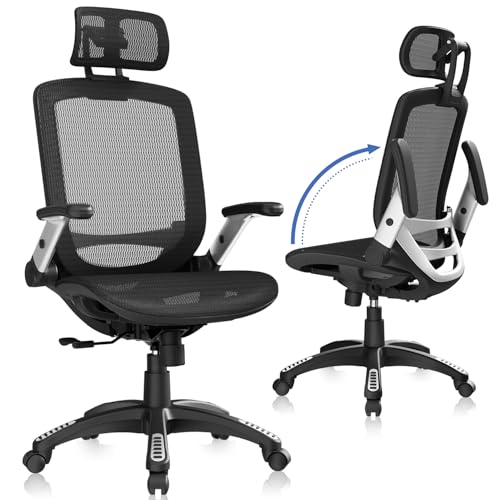
The GABRYLLY is a genuinely comfortable chair — for the frame it was built around, which is not a smaller one. Independent testing measured its seat height at 17.5 to 22 inches (the listing states 18.5 to 22.05) and called it among the tallest chairs they have tested at both ends: the bottom of its range sits above the other chairs' floors, so a shorter sitter starts from a seat that cannot come down to them. Its seat is a fixed 20 inches wide by 19.3 inches deep — the deepest pan in this guide, with no depth adjustment to pull it back.
The headrest completes the picture. It is adjustable, and in testing it suited taller sitters — testers under 5 ft 4 in could not reach it at its lowest setting. Add the lumbar: there is no adjustable lumbar support at all, only the fixed curve of the mesh back, so a smaller back gets whatever position that curve was moulded for. Its one smaller-space virtue is real — the flip-up arms let the chair tuck under a desk in a small room — but tucking under a desk is not the same as fitting the sitter, and it does not change a single measurement above. Our full review covers what it does well for the taller sitters it fits, and it leads our tall-users guide for exactly the reasons it is a skip here.
The larger-frame skip, with a verification step: Duramont

The Duramont's file runs in the larger direction as consistently as the GABRYLLY's. It is a high-back chair — back interior height 21.25 inches — built, in its review's words, with fit geared to large frames and a 330 lb rating. The same review is explicit about the other end: shorter testers struggled with the deep seat, and its who-this-is-for guidance tells shorter or petite readers to skip it, naming the fixed seat depth and the height of the back as the two things owners and testers agree do not suit smaller frames. A deep fixed seat is precisely the second check of this guide failed with no adjustment to recover it.
Fit check: run the first check of this guide yourself before buying in either direction. Our review records the Duramont's overall dimensions (26 × 23.6 × 42 inches) but no seat-height range, so we will not print one here — a smaller buyer would need the listing's figure to bottom out at their feet-flat point, on a chair whose recorded traits already point the other way. Its adjustable lumbar moves only a small range in testing, and independent hands-on testing rates it a chair for a few hours a day rather than a full eight-plus; our full review has the detail.
When none of the four fits
If your legs need a seat floor below 17 inches or a pan shallower than a 16.25 inch slide setting, you are outside what we review, and this guide's job there is to hand you the checks, not a fifth name. Shop the petite class on its published measurements: a seat-height range whose bottom end clears your feet-flat point with room to spare, a fixed seat depth shallower than 18 inches or a depth slide that runs below the shallowest setting above, a lumbar support stated to adjust in height so it can come down to your back, and every figure taken from the manufacturer's specifications rather than a listing headline, having seen above how far those two can drift apart.
And do not improvise around the mismatch. A footrest under a too-high chair restores a foot platform, but the seat depth, back height and lumbar position stay exactly where they were — the parts that already overshot still overshoot. The same goes for sitting on a cushion to reach the desk: it raises you relative to the desk while raising you off the seat's own support geometry too. If, on the other hand, your measurements land inside the ordinary band, you do not need a smaller-specific shortlist at all: our ergonomic office chair guide splits the same four chairs on the general checks — sitting hours, airflow, and adjustment depth — and our ergonomic desk setup guide fits the chair into the rest of the workstation.
Smaller-frame ergonomic chair questions, answered honestly
What seat height does a petite user actually need?
Low enough that your feet rest flat on the floor without the seat front pressing under your thighs — if the seat bottoms out above that point, your feet dangle and you slide forward to find the floor. Judge chairs by the bottom of their seat-height range: of the four we review, the HON Ignition 2.0 goes lowest at 17 to 21 inches, the SIHOO M57 starts at about 17.1 inches with about 4 inches of travel, and the GABRYLLY starts at 17.5 inches as measured in independent testing. Our Duramont review records no seat-height range, so confirm that figure on its listing before treating it as a smaller-frame pick.
Why does seat depth matter so much for smaller users?
Shorter legs need a shallower seat pan: too deep and the front edge presses behind your knees, so you either perch on the edge without back support or slouch back into it. Depth is the least adjustable dimension in this class — only one of the four chairs we review adjusts it, and the HON Ignition 2.0's seat-depth slide runs down to 16.25 inches, the shallowest setting we review. The SIHOO M57's seat is a fixed 18.11 inches deep, the GABRYLLY's a fixed 19.3 inches, and the Duramont's deep fixed seat is the trait its own feedback says punishes shorter users.
Which reviewed chair fits smaller frames best?
The SIHOO M57 is the smaller-frame pick in our coverage: hands-on reviewers conclude it fits small-to-average frames best, its seat starts at about 17.1 inches, and its lumbar support adjusts in both height and depth, so it can be brought down and in to a smaller back. If seat depth is your deciding check, the HON Ignition 2.0 is the other answer — its slide reaches 16.25 inches, shallower than any fixed pan we review, and its seat goes lowest at 17 inches. The GABRYLLY and the Duramont are the two to skip: their seats start high and run deep.
Can a footrest fix a chair that is too high?
It fixes one symptom — dangling feet — and none of the others. A foot platform restores somewhere for your feet to rest, but the seat depth, back height, lumbar position and headrest reach all stay where the chair put them, so a too-deep seat still presses behind your knees and a too-high lumbar still lands in the wrong place. Treat a footrest as a workaround for a chair you already own, not as a reason to buy a chair whose published measurements overshoot your frame.
What if none of the four chairs goes low or shallow enough?
Then shop the petite class on its published measurements rather than stretching one of these: a seat-height range whose bottom end lands below the 17 inches that is the lowest floor we review, a seat depth shallower than 18 inches or a depth slide that runs below the HON's 16.25 inches, and a lumbar support stated to adjust in height so it can come down to a smaller back. Take every figure from the manufacturer's specifications rather than a listing headline — the chairs above show how far those two can drift apart on the same model.
Bottom Line
Run the three checks, then read the four chairs in order
Measure first — feet flat for seat height, knee clearance for depth, low reach for the lumbar. When frame fit and lumbar travel decide it, the SIHOO M57 is the smaller-frame pick: the chair reviewers conclude fits small-to-average frames, with a lumbar that adjusts in height and depth. When leg length decides it, the HON Ignition 2.0 and its 16.25 inch slide setting are the shallowest answer we review. And let the other two go: the GABRYLLY's seat starts among the tallest measured and its headrest overshoots shorter sitters, and the Duramont's deep seat and tall back are built for larger frames. Taller reader instead? See our ergonomic chair guide for tall users. For the general comparison, see our ergonomic office chair guide, or browse all our chair reviews.