
Buying Guide — Standing Desks
Best Standing Desk for Shorter Users
The short answer first: a shorter user's desk choice is decided by one number — the bottom of the height range. Three of the four electric desks we've reviewed stop at 28 to 28.9 inches, which quietly floats the desktop above a shorter seated user's elbows for most of the working day; the fourth drops to 25.3. But your height is the wrong thing to compare against those floors. Your seated elbow height is the right one — here's the test to run, then how the four desks split for the bodies that measure small.
Affiliate disclosure: Home Office Stack is a participant in the Amazon Services LLC Associates Program. As an Amazon Associate, we earn from qualifying purchases made through links on this page — at no extra cost to you. Picks are research-based, grounded in manufacturer specs and published owner feedback; we don't accept sponsored placements.
Measure your seated elbow, not your height
"Suitable for users from 5 foot 2" is a claim about nobody. Two people of exactly the same height can need desktop heights inches apart, because what sets the number is where the elbow lands seated — and that depends on how the height splits between legs and torso, and on the chair under them. A shorter user with a longer torso can sit comfortably at a range that leaves a shorter-torsoed user of the same height reaching up to the keyboard. Listings print the height claim because it's simple; the range printed beside it is the fact. Shop the range — from the bottom.
The seated elbow test takes a minute. Sit in your work chair with your feet flat on the floor — not hooked on the chair's base. Let your upper arms hang relaxed at your sides, bend your elbows until your forearms are level, and measure from the floor to the underside of your elbow. Your desktop wants to land at or just below that number: keyboard under your hands, shoulders down, feet still flat. Run the same test standing against the desk's maximum; shorter users clear most maximums easily, but a saved pair of heights only works if both ends fit — our standing desk setup guide walks through saving and using the two.
The symptom of a missed floor is quiet. A desktop two inches too high doesn't announce itself. It shows up as shoulders that creep toward your ears by mid-afternoon, forearms pressing on the desktop's edge, and a chair slowly raised until your feet lose the floor — at which point the desk has quietly cost you your foot support too. And read the range's basis before you trust it: two of the desks below publish one figure for the frame and a taller one that includes the desktop, and your elbow meets the desktop. The including-the-top figure is the honest comparison — the FAQ at the bottom of this page does that arithmetic desk by desk.
The desks we've reviewed, compared by floor
| VIVO Electric 63 x 32 Inch Standing Desk | The low pick — the widest range we cover, and the only floor below 28 in | 63.1 × 31.5 in · 25.3–51 in range incl. top · 3 presets + timer | 176 lb on the desktop, per its manual |
| SHW 48-Inch Electric Standing Desk | The complete box at the lowest 48-inch floor — drawer and cable tray included | 48 × 24 in · 28–45 in range · 4 presets | 110 lb limit, per its manual |
| Marsail Electric Standing Desk | A 28.3 in floor, plainer — capacity and presets, almost nothing else in the box | 48 × 24 in · 28.3–46.5 in range · 4 presets | 176 lb rating · hook and cable clip only |
| FLEXISPOT EN1 One-Piece Standing Desk | The seamless top on the highest floor we review — fits only when the test lands at 28.9 in or above | 48 × 24 in · 28.9–46.5 in range incl. top · 4 presets | 176 lb limit · no drawer or cable tray included |
Specs above are the manufacturers' figures as recorded in each product's full review on this site, stated on the including-the-top basis wherever the review records both. Read the table's honest shape: this is a one-desk answer for genuinely low seated elbow heights, a three-desk answer in the band at 28 inches and above, and a real tension running through it — the desk that goes lowest is also the desk that takes the most room, which is why the workarounds in the last sections matter as much as the picks.
Below 28 inches, only one reviewed desk goes: VIVO 63 x 32

The VIVO is the shorter pick for the same reason it is our tall pick: its range is built differently. Three-stage telescopic legs — against the two-stage columns of the 48-inch desks — buy a span of 25.3 to 51 inches including the top, per its 2E Series manual. That floor is 2.7 inches below the next-lowest desk we review, and it is the whole argument: if your seated elbow test lands at 26, 27 or 28 inches, this is not the best of four options, it is the only one of the four whose desktop can physically arrive at your elbows while your feet stay flat on the floor. The same legs make it the one desk here that also reaches a tall standing user, which is why shared households of very different heights keep landing on it.
The rest of the desk can carry the setup around those elbows. The curved top is 63.1 by 31.5 inches — 28 inches deep at the centre where you actually sit — with room for two large monitors and a laptop, and the manual's load figure is 176 lb on the desktop. The touch-screen controller stores three presets and adds timer reminders, so the low seated height and the standing height are both one press away. Owner feedback praises a quiet, smooth lift and legs described as seriously beefy.
Fit check: the price of the lowest floor is the largest footprint — and shorter users are disproportionately the ones working in small rooms, so this trade is the guide's central tension, not a footnote. A 63-inch top needs its wall; the top arrives in three pieces whose seams some owners feel under the mouse; the desk ships in two cartons and its manual recommends two people for the build; and there is no drawer or cable tray in the box. Load to the manual's 176 lb figure, not the 220 lb frame-support figure in the listing title — our full review records both numbers and why they differ. If the room math rules the VIVO out, the honest fallback is not a higher desk bought hopefully — it is a 48-inch desk from the next section plus the footrest or keyboard-tray plan in the FAQ.
At 28 inches and above: the two 48-inch floors

If your seated elbow test — feet flat, forearms level — lands at 28 inches or above, the floor question is settled by the 48-inch pair, and the choice becomes an ordinary one about the box. The SHW 48-Inch pairs the lowest 48-inch floor we review, 28 inches, with the most complete box: a storage drawer, an under-desk cable tray, a desktop grommet, cable clamps and two utility hooks included, four presets, and a Walnut 48 by 24 inch top. For a shorter user in a small room, that combination is the practical centre of this guide — the smallest footprint here, at the lowest 48-inch floor, with nothing left to buy for the cables a sit-stand desk drags through its travel. Its honest limit sits on top of the desk rather than under it: a 110 lb capacity per its manual, the lowest figure we review, which a monitor arm and a pair of screens can approach faster than a laptop-only setup does.
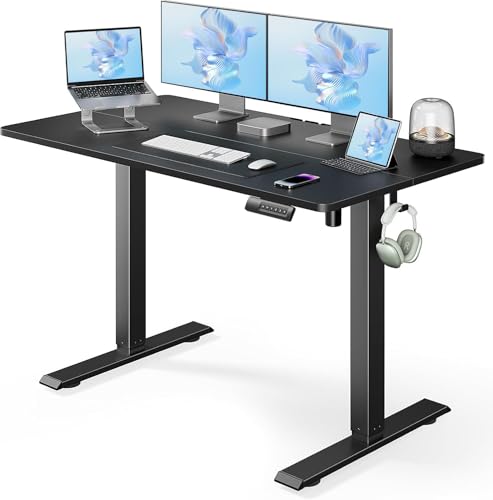
The Marsail stops 0.3 inches higher, at 28.3, and answers the SHW's capacity limit from the plainer direction: a 48 by 24 inch Black top on T-shaped steel legs, four presets, a 176 lb rating, a motor rated under 50 dB at about an inch per second — and a headphone hook and cable clip as the whole extras list. Its owner pool is smaller and newer than the SHW's, and it reads honestly mixed at the points that matter here: stability praised at sitting and mid-range heights, and some owners reporting the motor straining past about 100 lb despite the rating. On floor the SHW wins by a hair; on published capacity the Marsail wins on paper, with the feedback caveat attached.
Fit check: that 0.3 inch gap between the two floors is smaller than the difference between two pairs of shoes — if your test lands at exactly 28, either desk's floor is within measuring error of your elbow, and the box and capacity arguments should decide it. If it lands at 27, neither desk reaches you seated, whatever the gap looks like on paper, and the choice moves back to the VIVO or the workaround plan.
The FLEXISPOT EN1, honestly: only if 28.9 inches genuinely covers you
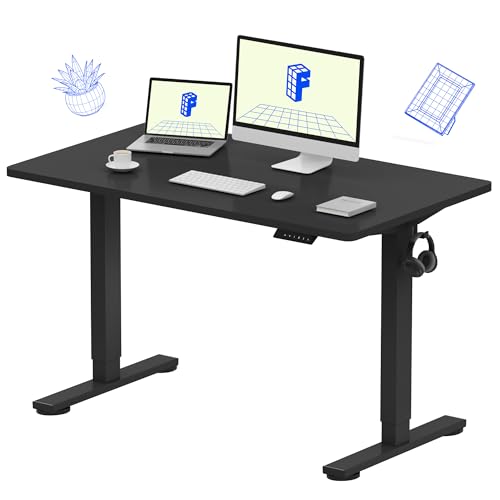
The EN1 earns its place in most of our standing-desk guides on its surface — a single seamless 48 by 24 inch desktop with no centre seam to catch a wrist or flex under a monitor-arm clamp, a 176 lb limit, four presets, and a single motor its manual rates under 50 dB. For a shorter user it comes with the highest floor we review: 28.9 inches including its 1-inch top, 28.1 for the frame alone. That still fits a real slice of shorter readers — height alone doesn't set seated elbow height, and a shorter user whose proportions and chair land the test at 29 inches or above gets the best surface here without paying for range they will never use.
Fit check: this is the desk where the measurement discipline matters most, because the temptation runs the other way — the top is good enough to invite buying first and hoping. Hope is not a range. If your test lands below 28.9, the EN1 cannot be preset or accessorized down to your elbows; its controller also mounts on the right side of the desktop only, and there is no drawer or cable tray in the box. Measure, and if the number is under, let the surface go — or buy it knowingly, with the footrest plan in the questions below already priced into the setup.
When none of the four goes low enough
A seated elbow height under 25.3 inches puts you outside everything we review, and this guide's job there is to hand you the checks and the workarounds, not a fifth name. Shop the low-floor class on its own published figures: a minimum — stated including the desktop — below your measured seated elbow height with room to spare; three-stage legs, which are what buy the span in the one wide-range desk in our coverage; and a load figure taken from the manual rather than a listing headline. What not to do is improvise the difference at the feet: a frame's stability assumes its feet flat on the floor, and blocks or risers under the legs trade a fit problem for a tip problem.
The workarounds deserve their honest paragraph, because for many shorter users they are the actual answer. Raising the chair until your elbows meet a 28-inch desktop works, provided a footrest restores the floor your feet lost — our ergonomic chairs for smaller users guide runs the matching chair-side checks, seat depth first. A keyboard tray mounted under the desktop takes the other route, bringing the keyboard down to your elbows instead of raising you to the desk. And if your elbow test lands inside the ordinary band — say 28 inches and above — you do not need a low-floor desk at all: our standing desks for a home office guide splits the same four desks on the general checks, the small spaces guide runs the room math for the 48-inch desks, and the tall users guide covers the other end of the same ranges. This page exists for the readers those guides' floors exclude.
Shorter standing desk questions, answered honestly
How low does a standing desk need to go for a shorter user?
As low as your seated elbow height — that number, not your height, decides it. Standing is rarely the problem for a shorter user: every desk we review rises well past a shorter standing elbow. Sitting is where the range runs out. The four reviewed desks bottom out at 25.3 inches (VIVO, including its top), 28 inches (SHW), 28.3 inches (Marsail) and 28.9 inches (FLEXISPOT EN1, including its top). If your seated elbow height — measured with feet flat and forearms level — lands below a desk's floor, that desk sits too high for you at its lowest, and no preset changes a printed range.
How do I measure the seated desk height I actually need?
Sit in your chair with your feet flat on the floor — not on the chair's base or a rung. Let your upper arms hang relaxed, bend your elbows so your forearms are level, and measure from the floor to the underside of your elbow. Your desktop wants to land at or just below that number, so the keyboard sits under your hands without your shoulders rising toward your ears. Run the same test standing for the desk's top end. Then compare both numbers with a desk's published range, stated including the desktop — and leave a little room below your seated number rather than buying a floor that exactly equals it.
Does a desk's minimum height include the desktop itself?
Not always, and the difference decides shorter-user fits just as it decides tall ones. The VIVO's frame figure is 24.6 to 50.2 inches and its 25.3 to 51 inch figure includes the top. The FLEXISPOT EN1's frame range is 28.1 to 45.7 inches; its published 28.9 to 46.5 inch figure includes the 1-inch top. Your elbow meets the top surface, so the including-the-top figure is the one to compare — a desk that looks low enough on frame numbers can land almost an inch high in the room.
Can I just raise my chair to meet a desk that won't go low enough?
It is the standard workaround, and it works — with two costs to manage honestly. Raising the chair lifts your feet off the floor, and dangling feet put pressure under the thighs and leave your lower back unsupported by the floor, so a footrest at the right height is part of the fix, not an extra. It also raises your eyes, so the screen has to rise with you or your neck pays the difference. A keyboard tray mounted under the desktop is the other route: it puts the keyboard below the desk surface the frame cannot lower. Both are legitimate; neither changes the desk's printed floor, so measure first and treat them as planned parts of the setup, not surprises after delivery.
What if my seated elbow height is under 25.3 inches?
Then none of the four desks we review goes low enough on its own, and this guide will not stretch one to fit. Shop the low-floor class on its own published figures: look for a minimum — including the desktop — below your measured seated elbow height with room to spare, expect three-stage legs (they are what buy the VIVO's span in our coverage), and price in the workaround that closes any remaining gap, a footrest with a raised chair or an under-desk keyboard tray, from the start. A desk shimmed or blocked up at the feet is not a fix; a frame's stability figures assume its feet flat on the floor.
Why is sitting the problem when standing desks are sold on standing?
Because most sit-stand users still sit for most of the day, and the ranges are designed around the middle of the population. At the standing end, a shorter user's elbow height sits comfortably inside every reviewed range — the four desks top out at 45 to 51 inches. At the seated end, the same user's elbow can land below where three of the four frames stop. A desk that fits you standing and floats above your elbows sitting has only solved the smaller half of your day.
Bottom Line
Run the seated elbow test, then read the floors in order
Measure first — feet flat, forearms level, seated. Below 28 inches, the VIVO 63 x 32 is the only desk we review that reaches you with your feet on the floor, and its three-stage range is worth its size if the room allows it. At 28 or above on a 48-inch footprint, the complete-box SHW 48-Inch is the practical centre and the plainer Marsail the capacity alternative a third of an inch higher. At 28.9 or above, the seamless FLEXISPOT EN1 becomes a legitimate buy — measured, not hoped into. Under 25.3, buy nothing here and shop the low-floor class on its own figures, with the footrest or keyboard-tray plan priced in. For the whole setup around the desk, see our ergonomic desk setup guide, or browse all our standing desk reviews.