
Buying Guide — Chairs
Best Ergonomic Chair for Lumbar Support
The short answer first: "lumbar support" on a listing can mean a support that adjusts in height and depth, a panel that slides up and down, a pad that nudges over a small range, or nothing adjustable at all — just the curve a back was moulded into. Of the four chairs we've reviewed, one does the first, one the second, one the third, and one the fourth. Here are the three checks that tell them apart, then how the four split.
Affiliate disclosure: Home Office Stack is a participant in the Amazon Services LLC Associates Program. As an Amazon Associate, we earn from qualifying purchases made through links on this page — at no extra cost to you. Picks are research-based, grounded in manufacturer specs and published owner feedback; we don't accept sponsored placements.
Three checks decide whether lumbar support reaches you
Every ergonomic chair claims lumbar support; the claim is where the information stops. The lower backs these chairs meet are not in the same place — torso lengths differ, and so does the point where each sitter's back curves — and they do not all want the same amount of push behind that curve. A support feature helps only if it can be brought to your back, at your preferred firmness, while you sit the way you actually sit. These three checks test exactly that, in order.
First check: does the support move to where your lower back actually is? This is the height question. A lumbar pad or panel fixed at one height was placed for an average torso; on a shorter or longer back it lands above or below the curve it is meant to fill, where it does nothing or actively annoys. Height adjustment is the minimum credible meaning of "adjustable lumbar support," and the range matters as much as the existence of the control — a support that moves a small distance over the exact band where backs differ least is a weaker answer than one that travels widely. Of our four chairs, two move their support over a meaningful height range, one moves its support a small amount, and one cannot move at all.
Second check: can you change how hard it pushes? This is the depth, or intensity, question, and it is the one most listings leave unanswered. Two sitters whose backs curve at the same height can want opposite things behind them — one a distinct pad filling the curve, the other the faintest contact. A support that only moves up and down gives the first sitter no way to soften it and the second no way to strengthen it. Depth adjustment is rarer than height adjustment in this class: only one of the four chairs below offers both directions, and its manual is explicit on the point, which is why it leads this guide.
Third check: seat depth, the hidden lever. Lumbar support only works on a back that is actually against the backrest, sitting upright in the seat. A seat pan that is too deep for your legs breaks that posture before the lumbar gets a chance: its front edge presses behind your knees, so you perch forward without back contact, or you slide and slouch down into the seat, rounding your lower back away from the support entirely. No lumbar pad, however adjustable, fixes a slouch the seat depth is causing. That is why a seat-depth slide — a feature that sounds like a leg-comfort extra — is a lower-back feature in disguise, and why the one chair here that has one earns a second look in a lumbar guide.
When it is not a gear problem
One boundary before the chairs, stated plainly: lumbar support is a fit feature, not a treatment. The right support can remove a mismatch between a chair and a back, and it can make an ordinary working day more comfortable. It cannot diagnose why a back hurts, and a stronger pad is not the answer to every kind of discomfort. If you have persistent back pain, pain that radiates into a leg, numbness, or weakness, that is not a gear problem — see a clinician rather than shopping your way through chairs. Everything below is written for the ordinary case: a basically healthy sitter whose current chair's back simply does not meet theirs.
The chairs we've reviewed, compared by lumbar support
| SIHOO M57 Ergonomic Office Chair | The most adjustable lumbar here — adjusts in height and depth; split backrest shaped to the spine's curve | Seat depth fixed at 18.11 in, no depth adjustment · fits small-to-average frames best · rated to 330 lb |
| HON Ignition 2.0 Mid Back Task Chair | Integrated lumbar panel moves up and down over a wide range — but the panel is thin, unpadded plastic | The only seat-depth slide here, 16.25–19.25 in · seat height 17–21 in · rated to 300 lb |
| Duramont Ergonomic Office Chair | Lumbar adjusts up, down, in and out — but over a small range in testing; full-height back support | No seat-depth adjustment · fit geared to larger individuals · rated to 330 lb |
| GABRYLLY Ergonomic Office Chair | No adjustable lumbar support — the fixed curved contour of the mesh back only | Mesh seat and back comfort praised in testing · judge weight against 280 lb |
Read the table by the three checks, not by the length of each chair's feature list. The honest shape of this comparison is a ladder: one chair adjusts in both directions, one adjusts widely in one direction and adds the seat-depth lever, one adjusts in both directions but barely, and one asks you to accept its back's shape exactly as delivered. Which rung you need depends on what has already failed you — a fixed curve that never landed, a pad that landed but pushed wrong, or a seat that will not let you sit back at all.
The most adjustable lumbar: SIHOO M57

The M57 leads this guide on the first two checks together, because it is the only chair here that passes both. Its lumbar support adjusts in height and in depth — the model's manual is explicit on both directions, which matters, because listings in this class routinely blur the two into a single "adjustable" claim. Height travel lets the support be brought to where a given back actually curves; depth travel then sets how firmly it fills that curve, so the same chair can run a distinct, present support or a light contact without changing chairs. Behind the adjustment sits a split backrest shaped to the curve of the spine, so the moving support works within a back that was designed around the lower back's shape rather than a flat panel.
The rest of its file supports the dial-in story. The headrest adjusts over about 3.15 inches of travel and tilts to 45 degrees, the recline runs 90 to 126 degrees with three locking positions, the chair is rated to 330 lb, and it carries a 3-year warranty. None of that is lumbar support, but it is the context the lumbar sits in: this is the chair in our coverage built around adjustment as its main idea, and the lumbar is where that idea goes furthest.
Fit check: two honest limits, one per remaining check. The seat depth is fixed at 18.11 inches with no seat-depth adjustment, so the third check cannot be tuned on this chair — if your legs need a shallower seat, the HON below is the answer. And the fit runs small-to-average: sitters around six feet and up find the headrest and armrests running out of range, so a taller reader should treat its lumbar travel as travel inside a smaller chair. Our full review records the reviewer and owner feedback behind this section in full.
The wide-range panel and the depth lever: HON Ignition 2.0

The HON answers the first check with range. Its lumbar support is an integrated panel that moves up and down over a wide range — testing described its reach as covering almost any height — so on placement alone it is the strongest alternative to the M57: wherever your lower back sits along the backrest, the panel can be brought to it. What it does not adjust is depth. The panel's push is the panel's push, and the panel itself is thin, unpadded plastic rather than a cushioned pad — effective placement, honest material. A sitter who wants a soft, deep fill behind the curve should read that sentence twice; a sitter whose problem was purely that supports always landed in the wrong place has found the widest-ranging fix we review.
Where the HON pulls ahead of the M57 is the third check. Its seat-depth slide runs 16.25 to 19.25 inches — the only seat-depth adjustment among the four — so the posture the lumbar depends on can itself be adjusted: pull the seat back until there is a small gap behind your knees, and your back reaches the panel sitting upright instead of slouched. Its seat height runs 17 to 21 inches, it is rated to 300 lb, and it carries the HON Limited Lifetime Warranty, the longest coverage in this comparison by a distance.
Fit check: comfort tops out mid-road. Testing puts its comfortable window at about six hours, so a sitter whose lumbar complaint arrives in hour seven of unbroken sitting is asking this chair a question its window does not answer. Buy it for placement range and the depth slide; our full review records the testing behind both.
Adjustable on paper, small in practice: Duramont

The Duramont is this guide's lesson in reading past the directions count. Its lumbar support adjusts up, down, in and out — four directions, the same directions the M57 offers — but in testing the range of that movement is small. A support that travels a short distance can fine-tune a fit that is already close; it cannot rescue a fit that starts in the wrong place, which is the exact job the first check exists to test. Judge this chair's lumbar as a nudge, not a repositioning, whatever the listing's arrows suggest.
What the Duramont offers instead is coverage. Its back interior height is 21.25 inches with an integrated headrest, so support runs the full height of the back rather than ending at the shoulders, and the chair is rated to 330 lb with three recline positions and a 5-year warranty per its listing. Its fit is geared to larger individuals — the sitters its dimensions suit are the ones most likely to find its small lumbar range landing close enough to fine-tune in the first place.
Fit check: the third check fails with no recovery. Shorter testers struggled with the seat depth, there is no seat-depth adjustment to shorten it, and a deep fixed seat is precisely the posture problem the hidden lever describes — a smaller sitter slouches away from a lumbar support that can only move a small distance toward them. Our full review has the full fit picture.
The honest entry: no adjustable lumbar — GABRYLLY
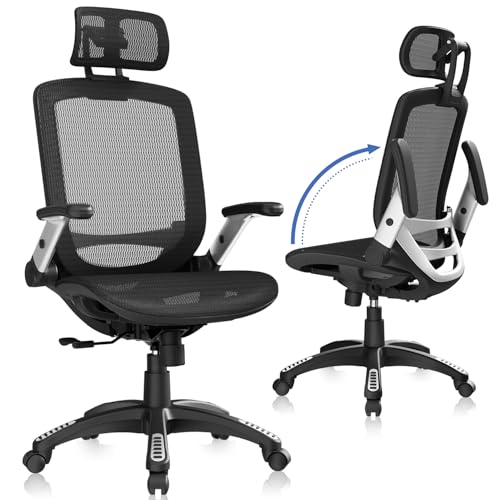
The GABRYLLY belongs in this guide as the worked example of the listing language the first section warned about. It has no adjustable lumbar support. Independent testing's specification table records adjustable lumbar as No, with the support level described as semi — what the chair actually has is a fixed curved mesh contour, a back moulded into a curve. When its listing says "lumbar support," that curve is what the words mean. There is nothing to move in height, nothing to tune in depth, and no setting to change if the curve lands in the wrong place on your back.
None of that makes it a bad chair — for the back its curve happens to fit, it may never give its owner a reason to think about lumbar support at all. Its mesh seat and back were praised for comfort in testing, with a comfortable window of roughly seven hours for the test panel, and its headrest suits taller sitters — though readers under 5 ft 4 in could not reach it at its lowest setting, and its published weight figures conflict, so judge it against the conservative 280 lb. The point for this guide is narrower: buy it, if you buy it, for mesh comfort and fit as delivered — never as an adjustable-lumbar purchase. Our full review covers what it does well on those terms.
Setting the support once the chair is home
Whichever rung of the ladder you buy, the order of setup is the order of the checks. Sit in the chair as you will actually work — feet supported, back against the backrest — before touching the lumbar control, because the support has to be placed against a real posture, not a showroom one. Set the seat depth first if your chair slides: a small gap behind your knees, close enough that your back reaches the backrest without reaching. Then place the lumbar in height, at the small of your back where the curve turns inward, and only then set its depth if it adjusts — starting lighter than you think, since a support set too firm is the one owners abandon within a week, and increasing it over a few days tells you more than a single afternoon's impression.
Give the setting days, not minutes, before judging it — and judge it by the end of an ordinary working day, not by how it feels in the first sit. If discomfort arrives with numbness, radiating pain, or weakness at any point, stop treating it as a setup problem: that is the boundary from the section above, and it points to a clinician, not to another adjustment. For how a chair's lumbar fits into the wider workstation, our ergonomic desk setup guide treats the chair as one layer of four, and our ergonomic office chair guide splits these same four chairs on the general checks.
Lumbar support questions, answered honestly
What does adjustable lumbar support actually adjust?
Two different things, and a chair may offer one without the other. Height adjustment moves the support up or down the backrest so it can land where your lower back actually curves. Depth adjustment changes how far the support pushes into that curve — how firm the contact feels. Of the four chairs we review, only the SIHOO M57 adjusts in both directions; the HON Ignition 2.0's panel adjusts in height over a wide range, the Duramont adjusts in both directions but over a small range in testing, and the GABRYLLY does not adjust at all.
Which reviewed chair has the most adjustable lumbar support?
The SIHOO M57. Its manual is explicit that the lumbar support adjusts in height and in depth, which makes it the most adjustable lumbar pick we review. The HON Ignition 2.0 is the other serious answer if height placement is your problem: its integrated panel moves up and down over a wide range, though the panel itself is thin, unpadded plastic. The Duramont also adjusts up, down, in and out, but testing found the range small.
Does the GABRYLLY have adjustable lumbar support?
No. Independent testing's specification table for the GABRYLLY records adjustable lumbar support as No, with the support level described as semi — what the chair has is the fixed curved contour of its mesh back. Its listing uses the words lumbar support, but that refers to the shape of the back, not to a support you can move or tune. If a fixed curve has already failed your back, this chair offers nothing new to adjust.
Can the right lumbar support fix back pain?
No — and no chair on this page should be bought on that basis. Lumbar support is a fit feature: it can remove a mismatch between a chair's back and yours, and it can make ordinary sitting more comfortable, but it is not a treatment and it does not diagnose anything. If you have persistent back pain, pain that radiates into a leg, or numbness or weakness, that is not a gear problem — see a clinician rather than shopping for a stronger lumbar pad.
Why does seat depth matter if I am shopping for lumbar support?
Because seat depth decides whether you can reach the lumbar support at all. A seat that is too deep puts its front edge behind your knees, so you either perch forward away from the backrest or slouch down into the seat — and in the slouch, your lower back rounds away from wherever the support sits. The HON Ignition 2.0 is the only chair we review with a seat-depth slide, running 16.25 to 19.25 inches, which makes it an indirect lower-back fit lever as well as a leg-comfort one.
Bottom Line
Run the three checks, then read the ladder in order
Ask whether the support reaches your back, whether you can set how hard it pushes, and whether the seat lets you sit back into it at all. When both kinds of adjustment decide it, the SIHOO M57 is the most adjustable lumbar pick we review — height and depth, in a chair sized for small-to-average frames. When placement range and seat depth decide it, the HON Ignition 2.0 pairs the widest-moving panel with the only depth slide here. The Duramont fine-tunes a larger frame's fit over a small range, and the GABRYLLY offers a fixed curve and honest mesh comfort — and no adjustment at all. For the general comparison, see our ergonomic office chair guide, or browse all our chair reviews.