
Buying Guide — Chairs
Best Ergonomic Chair for Long Hours
The short answer first: a chair that feels fine in a twenty-minute sit can fail in hour six, and the four chairs we've reviewed carry very different evidence on exactly that point — tested windows from at least seven hours down to four to five, with one chair explicitly not the pick for eight-plus-hour sitting. Here are the three checks that tell them apart, then how the four split.
Affiliate disclosure: Home Office Stack is a participant in the Amazon Services LLC Associates Program. As an Amazon Associate, we earn from qualifying purchases made through links on this page — at no extra cost to you. Picks are research-based, grounded in manufacturer specs and published owner feedback; we don't accept sponsored placements.
Three checks decide whether a chair lasts a long day
Every ergonomic chair claims all-day comfort; the claim is where the information stops. A long day is not a longer version of a short sit. Pressure builds, foam changes under sustained load, a warm room gets warmer, and a posture that felt neutral at nine in the morning is the posture your back is tired of by three. These three checks test what actually changes across those hours, in order.
First check: the tested comfortable window. This is the spine of the guide, because it is evidence rather than adjectives. How long did testers, reviewers or owners actually sit in the chair before comfort ran out? The four chairs split cleanly: three independent testers said they could sit in the GABRYLLY for at least seven hours; reviewers who write six to eight hours a day credit the SIHOO M57's airflow and seat edge; the HON Ignition 2.0's tested comfortable window is about six hours; and independent testing rated the Duramont comfortable for four to five hours and explicitly not the pick for eight-plus-hour sitting. A chair whose window ends before your day does is the wrong chair however good its first hour feels.
Second check: what the seat surface does by hour six. Seat material is a long-hours feature because surfaces behave differently under a full day of load. Mesh that stays taut keeps its shape and breathes: the GABRYLLY's mesh stays tight and does not bottom out per owners, and the SIHOO's full-mesh seat is why its long-day reviewers credit airflow. Foam starts from the opposite direction. The HON's foam seat flattens on prolonged sits, which is part of why its window stops at about six hours, and the Duramont's thick foam cushion starts firm and softens with use. The SIHOO adds a wrinkle of its own: its mesh is firm at first and needs about a one-week break-in, so judge it after that week, not on day one.
Third check: position changes across a long day. Nobody should hold one posture for eight hours, so the useful question is how much movement a chair permits without leaving it. Tilt ranges and locks are micro-break tools: a chair that reclines and holds several positions lets you shift load through the day, while a narrow range keeps you where you started. Arms and headrests set the limits of those shifts — flip-up arms that only adjust in height, 3D armrests that move further, a headrest with real travel, or no headrest at all. Read each chair below for how far its positions actually move, not for how many levers it has.
No chair makes eight hours of still sitting healthy
One boundary before the chairs, stated plainly: no chair makes eight hours of still sitting healthy, and a chair is not a treatment. The right chair can remove a fit mismatch, spread pressure more evenly, and let you change position — all real gains. It cannot substitute for the thing that actually fixes a long sitting day, which is breaks and movement: stand up, walk, change posture, and let a recline be a pause rather than a new fixed position. Everything below is written for choosing the least-bad seat for a long day, not for making the long day itself harmless. If you have persistent pain, pain that radiates into a leg, or numbness or weakness, that is not a gear problem — see a clinician rather than shopping your way through chairs.
The chairs we've reviewed, compared for long hours
| GABRYLLY Ergonomic Office Chair | At least 7 hours in testing — three independent testers · all-mesh seat and back that stays tight and does not bottom out per owners · no adjustable lumbar, fixed mesh curve only · 90–120° tilt with 3-stage lock | Best for taller sitters who run warm and need no lumbar adjustment · headrest unreachable under 5 ft 4 in · judge weight against 280 lb |
| SIHOO M57 Ergonomic Office Chair | Six to eight hours a day — reviewers who write in it · full-mesh seat and split back, firm with about a one-week break-in · lumbar adjusts in height and depth, the longest travel of the four · recline runs 90 to 126 degrees with three locking positions | Best for small-to-average frames who need lumbar adjustment · ranges run out around 6 ft · seat depth fixed at 18.11 in |
| HON Ignition 2.0 Mid Back Task Chair | About six hours in testing · foam seat that flattens on prolonged sits · lumbar panel moves over a wide height range but is thin, unpadded plastic · advanced synchro-tilt with 3 limiter points | Best for about-six-hour days and shared desks · the only seat-depth slide here, 16.25–19.25 in · no headrest on this configuration |
| Duramont Ergonomic Office Chair | Four to five hours in testing; explicitly not for eight-plus · thick foam cushion, firm at first and softens with use · lumbar adjusts up, down, in and out, but over a small range in testing · tilt with tension knob and limiter, 3 recline positions | Best for part-to-moderate days — not long hours · fit geared to larger frames · the honest skip in this guide |
Read the table by the three checks, not by the length of each chair's feature list. The honest shape of this comparison is two long-day picks split by frame and by whether the lumbar must move, one conditional chair whose window and warranty suit a shorter or shared day, and one chair that belongs here as a skip — included precisely because its listing language sounds like an all-day chair while its testing says otherwise.
The long-day pick for taller, warm sitters: GABRYLLY
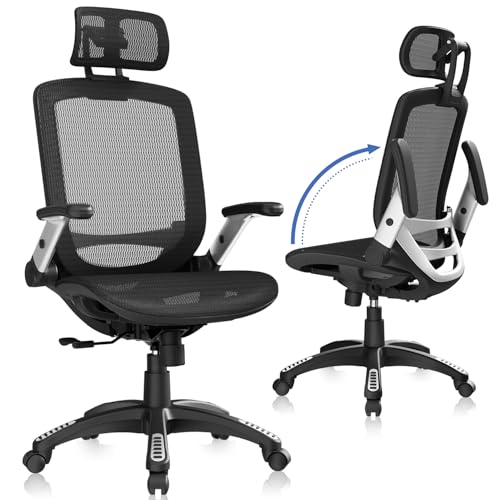
The GABRYLLY leads on the first check outright. Three independent testers said they could sit in it for at least seven hours — the longest tested window of the four — and its own listing aims it at four-to-eight-hour sitting in warm rooms, which is the use its construction suits. The seat and the back are both mesh, the seat is 20 inches wide, and the measured seat height runs 17.5 to 22 inches, so the chair underneath that window is a high, wide, breathable one. For a taller sitter who runs warm, that combination is the long-day argument in full.
On the second check, its mesh holds up the way a long day requires: owners report the mesh stays tight and does not bottom out, so hour six sits on roughly the surface hour one did, with airflow a foam seat cannot offer. On the third, its tilt runs 90 to 120 degrees with a 3-stage lock, and its flip-up arms adjust in height only — useful for getting the arms out of the way, limited for fine positioning. Its adjustable 3D headrest in practice suits taller sitters: testers under 5 ft 4 in could not reach it at its lowest setting.
Fit check: there is no adjustable lumbar here at all — only the fixed curve of the mesh back — so buy it only if a fixed curve has not already failed you. Judge weight against the conservative 280 lb, and note the 3-year warranty per its listing. Our full review records the testing and owner feedback behind this section.
The long-day pick when adjustment decides it: SIHOO M57

The M57's long-day evidence comes from the people who live in it: reviewers writing six to eight hours a day credit the airflow of its full-mesh seat and split back, and the waterfall seat edge, for getting them through those days. That is a different kind of evidence from a test panel — sustained, ordinary, repeated — and on this question it counts for a lot. The mesh is firm at first and needs about a one-week break-in, so its long-day verdict is one to confirm after that week rather than in a first sit.
What separates it from the GABRYLLY is adjustment. Its lumbar support adjusts in height and in depth — the longest travel of the four chairs here — so a sitter whose back needs the support placed and then tuned can keep tuning it as the day changes how the chair feels. Its 3D armrests move further than height-only arms, and its headrest has about 3.15 inches of travel and tilts to 45 degrees, which makes its micro-break positions genuinely different from its working position.
Fit check: it fits small-to-average frames despite its big-and-tall title — its ranges run out around 6 ft — and its seat depth is fixed at 18.11 inches. It is rated to 330 lb and carries a 3-year warranty. Our full review records the reviewer and owner feedback in full.
The conditional six-hour pick: HON Ignition 2.0

The HON is the honest middle of this guide. Its tested comfortable window is about six hours — a real working block, and less than a full sitting-all-day claim — and the reason is visible in the second check: its foam seat flattens on prolonged sits. For a day built around six hours at the desk, or a desk shared between sitters who each sit for part of it, that window can be exactly enough. For an unbroken eight-hour sit, the testing is telling you in advance where it ends.
Its adjustment story is why it earns the conditional place rather than a skip. It is the only chair here with a seat-depth slide, running 16.25 to 19.25 inches, its seat height runs 17 to 21 inches, its lumbar panel moves over a wide height range (though the panel is thin, unpadded plastic), its arms adjust in height and width, and its advanced synchro-tilt has 3 limiter points for changing position through the day. It is rated to 300 lb and carries the HON Limited Lifetime Warranty, the longest coverage here by a distance.
Fit check: there is no headrest on this configuration, so its recline is a lean, not a rest. Buy it for the slide, the panel range and the warranty on a roughly six-hour pattern; our full review has the testing behind the window.
The honest skip for long hours: Duramont

The Duramont belongs in this guide as the worked example of why the first check leads. Independent testing rated it comfortable for four to five hours and explicitly not the pick for eight-plus-hour sitting. That is not a marginal miss on a long-hours question — it is the testing answering the question directly, in the negative. A reader shopping specifically for long hours should take that answer at face value and look at the two picks above.
Judged on a shorter day, its file is respectable. Its thick foam cushion — the listing says memory foam — starts firm and softens with use, its high-back mesh has a 21.25-inch back interior with an integrated headrest that divided testers, its lumbar adjusts up, down, in and out but over a small range in testing, and its arms adjust in height, with fore-aft movement of about an inch only by loosening screws. Tilt has a tension knob and a limiter, with 3 recline positions. It is rated to 330 lb, with a 5-year warranty per its listing.
Fit check: none of that extends its window. Buy it, if you buy it, as a part-to-moderate-day chair for a larger frame — not as a long-hours chair working up to a longer day. Our full review covers what it does well on those terms.
Using a long-day chair across a long day
Whichever window you buy inside, how you use the hours matters as much as the chair. Break the day up before discomfort tells you to: stand, walk, and change posture at regular points rather than waiting for hour six to announce itself. Use the tilt and lock positions as micro-breaks — a short recline that shifts load is a pause, and it works best when it is brief and frequent rather than a single long lean at the end of the day. Reset the chair when you return: back against the backrest, lumbar where you set it, arms at a height that lets your shoulders drop.
Judge a new chair by the end of an ordinary working day, after any break-in period — the SIHOO's firm first week is the standing warning against day-one verdicts — and judge it across several days, not one unusually long one. If discomfort arrives with numbness, radiating pain, or weakness at any point, stop treating it as a setup problem: that is the boundary from the section above, and it points to a clinician, not to another adjustment. For how a chair fits the wider workstation, our ergonomic desk setup guide treats the chair as one layer of four, and our ergonomic office chair guide splits these same four chairs on the general checks.
Long-hours questions, answered honestly
Which reviewed chair lasts longest in a working day?
The GABRYLLY has the longest single tested window: three independent testers said they could sit in it for at least seven hours. The SIHOO M57 is close in a different way — reviewers who write six to eight hours a day in it credit its airflow and waterfall seat edge. The HON Ignition 2.0 was tested comfortable for about six hours, and independent testing rated the Duramont comfortable for four to five hours and explicitly not the pick for eight-plus-hour sitting. Those windows also assume breaks; none of them is a licence to sit still all day.
Is mesh or foam better for sitting all day?
For long hours, the evidence here favours mesh that stays taut. The GABRYLLY's all-mesh seat stays tight and does not bottom out per owners, and the SIHOO M57's full-mesh seat breathes through a long day, though it is firm for about a one-week break-in. Foam behaves differently: the HON Ignition 2.0's foam seat flattens on prolonged sits, which is part of why its tested window is about six hours, and the Duramont's thick foam cushion starts firm and softens with use inside a four-to-five-hour window. Surface alone does not decide fit, but by hour six it is usually what you notice first.
Which chair should I choose for long hours if I need adjustable lumbar support?
The SIHOO M57. It is the long-day pick for small-to-average frames who need adjustment, because its lumbar support adjusts in both height and depth — the longest travel of the four chairs we review. The GABRYLLY, the other long-day pick, has no adjustable lumbar at all, only the fixed curve of its mesh back, and the HON Ignition 2.0's lumbar panel moves over a wide height range but is thin, unpadded plastic. If lumbar adjustment is the reason you are shopping, the M57 is the only chair here that combines it with a six-to-eight-hour owner window.
Can an ergonomic chair make eight hours of sitting healthy?
No. No chair on this page — or anywhere — makes eight hours of still sitting healthy. A better chair can remove fit mismatches, spread pressure, and let you change position, but breaks and movement are the actual fix: stand up, walk, and change posture through the day. A chair is not a treatment, and it does not diagnose anything. If you have persistent pain, pain that radiates into a leg, or numbness or weakness, see a clinician rather than shopping for a different chair.
Which reviewed chair should I skip for long hours?
The Duramont, on this specific question. Independent testing rated it comfortable for four to five hours and explicitly not the pick for eight-plus-hour sitting, even though its thick foam cushion softens with use and its high-back mesh and integrated headrest suit larger frames for a part-to-moderate day. It carries a 330 lb rating and a 5-year warranty per its listing, so it is not a bad chair — it is simply the wrong answer when the question is sitting all day.
Bottom Line
Match the window to your day, then move inside it
Ask how long the chair was actually tested or lived in, what its seat surface does by hour six, and how far its positions let you move. When the longest tested window decides it, the GABRYLLY is the long-day pick for taller sitters who run warm and do not need lumbar adjustment. When adjustment decides it, the SIHOO M57 is the long-day pick for small-to-average frames, with lumbar travel in height and depth. The HON Ignition 2.0 is the conditional pick for about-six-hour and shared-desk days, and the Duramont is the honest skip for long hours. For lumbar adjustment in depth, see our lumbar support guide; for the general comparison, see our ergonomic office chair guide, or browse all our chair reviews.