
Buying Guide — Mice
Best Mouse for Travel
A desk mouse is judged where it lives; a travel mouse is judged everywhere else — in the bag on the way, on whatever battery discipline you actually keep, and on the surface waiting at the other end, which is rarely a desk with a mouse pad on it. Of the four mice we've reviewed, one is the smallest and lightest body with a battery measured in years, one removes the surface question entirely because it never moves, one carries the only sensor in our coverage recorded as tracking on glass, and one is a tall vertical body that a bag punishes more than any desk rewards. Here are the three checks a trip runs, then how the four split.
Affiliate disclosure: Home Office Stack is a participant in the Amazon Services LLC Associates Program. As an Amazon Associate, we earn from qualifying purchases made through links on this page — at no extra cost to you. Picks are research-based, grounded in manufacturer specs and published owner feedback; we don't accept sponsored placements.
Three checks decide it, and a desk never runs them
First check: packed size and shape. At a desk, a mouse's dimensions describe fit; in a bag, they describe luggage. Length and width matter, but height is the dimension that decides how a mouse travels — a flat body slides against a laptop or into a sleeve pocket, while a tall body needs a pouch of its own and arrives as a lump whatever it shares a compartment with. The four mice here span that range honestly: the compact Lift at 4.25 inches long, the full-size MX Master 3S at 4.92, the wide, flat trackball at 5.28 by 3.94 but only 1.89 tall, and the MX Vertical standing 3.09 inches — the tallest body we review. Weight tells the same story in miniature, from 4.4 ounces to just over five. None of these is a pocket mouse, and this guide does not pretend otherwise; the check is which reviewed body costs your bag the least.
Second check: power you do not have to think about. A travel mouse dies at the worst moment by definition — the morning of the presentation, the first hour in the coworking space — so the question is not battery life in the abstract but which failure you would rather manage. Two of the four run on a single AA battery rated in years and months: up to 24 months for the Lift, up to 18 for the trackball. Those mice effectively cannot run out mid-trip, and a spare cell is buyable almost anywhere on earth; the cost is carrying the spare and trusting a gauge that gives little warning. The other two are rechargeable — up to 70 days for the MX Master 3S, up to four months for the MX Vertical — and both carry the modern rescue: roughly three hours of use from a one-minute USB-C charge. That trade only works if the cable is actually in the bag, which is why this check is about your packing habits, not the spec sheet's biggest number.
Third check: the surface at the other end. Your desk at home is a known surface with a clear run on it. A trip offers a sequence of unknown ones: the glass-topped hotel desk, the shallow tray table, the café counter shared with a coffee, the hot desk with six inches of free space. A travelling optical mouse needs a surface it can track on and room to travel across it, and only one mouse in this guide carries a recorded answer to the glass problem — the MX Master 3S, whose Darkfield sensor is specified to track on glass of 4 mm minimum thickness. The other designs answer differently: the trackball needs no run at all, because the body never moves, so any stable patch its own size is a workstation. Judge this check against the trips you actually take, not the desk you are sitting at while you read.
The mice we've reviewed, compared by travel checks
| Logitech Lift Vertical Ergonomic Mouse | The travel pick — smallest body, longest battery | 4.25 × 2.76 × 2.80 in · 4.4 oz (125 g) · 57-degree vertical, right-hand Graphite | Single AA, up to 24 months · Bluetooth and Logi Bolt, up to 3 devices · quiet clicks |
| Logitech ERGO M575S Wireless Trackball Mouse | The no-surface pick — the mouse never moves | 5.28 × 3.94 × 1.89 in · 145 g with battery · stationary thumb trackball, right-hand only | Single AA, up to 18 months · Logi Bolt receiver stores inside the body · Bluetooth, 1 device |
| Logitech MX Master 3S Wireless Mouse | The glass-desk pick — the sensor that tracks on glass | 4.92 × 3.32 × 2.01 in · 4.97 oz (141 g) · sculpted conventional right-hand shape | Darkfield tracks on glass (4 mm min) · rechargeable, up to 70 days · 3 devices, Flow |
| Logitech MX Vertical Ergonomic Mouse | The honest skip for travel — the tall body a bag punishes | 4.72 × 3.11 × 3.09 in · 135 g · 57-degree vertical, right-hand only | Rechargeable, up to 4 months · Bluetooth, Unifying or wired · no receiver storage in the body |
Specs above are the figures as recorded in each product's full review on this site. Read the table's shape: each mouse wins exactly one of the three checks outright — the Lift wins the bag and the battery, the trackball wins the missing surface, the MX Master 3S wins the glass desk — and the fourth wins none of them once the desk is taken away, which is a finding about travel, not about the mouse.
The travel pick: Logitech Lift
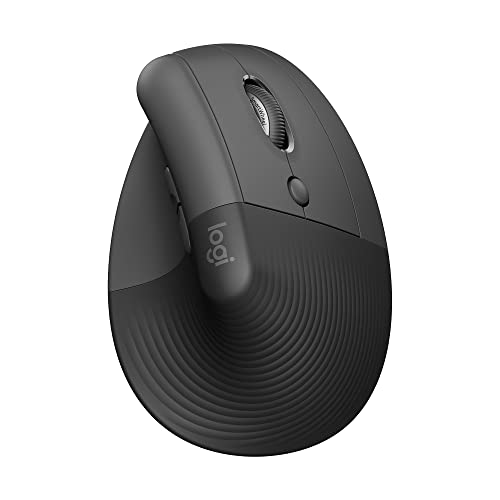
The Lift leads this guide because it wins the two checks a traveller feels first. It is the smallest body we review — 4.25 inches long, 2.76 wide — and the lightest at 4.4 ounces, so it costs a bag less than anything else here. And its battery removes the entire category of travel anxiety: a single AA cell rated up to 24 months means the mouse you packed in January is the mouse that works in October, with no cable, no charge check the night before, and no dead-mouse morning at the other end. If it ever does run low mid-trip, the fix is a battery bought at any airport or corner shop, not a charger hunt.
The rest of its file travels well too. It connects by Bluetooth or the included Logi Bolt receiver to up to three devices, so the same mouse pairs with the laptop in the bag and the machine at the other end; its clicks are quiet, which matters in the shared spaces travel work happens in; and the 57-degree vertical shape means the mouse you practise on at home is the posture you keep on the road, rather than a flat travel compromise your forearm relearns every trip. Our full review records the fit case in full — this is the small-to-medium hand's vertical — and our mouse guide for small hands reads the same body by reach alone.
Fit check: the one travel trade is height — at 2.80 inches tall it is a vertical body, so pack it in a pouch or its own pocket rather than flat against the laptop, where a tall shell and a screen should not be pressed together. It is right-hand in this Graphite listing, and it is not rechargeable, which this guide counts as a feature on the road and its own review counts as a limit at a desk.
The no-surface pick: Logitech ERGO M575S
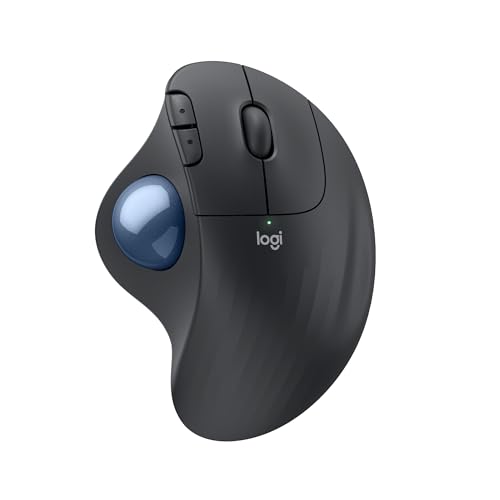
The M575S is the contrarian travel pick: the largest body in this guide, and the one that works where the others cannot. A stationary thumb trackball never moves on the surface, so the third check simply disappears — a tray table, a narrow ledge, the corner of a café table, a keyboard tray in a rented office: if the body fits, you can point, with no mouse run to find and no pad to pack. For travellers whose work happens in genuinely tight spaces, that is worth more than the inches it costs the bag, and the body is at least flat — 1.89 inches tall, the lowest profile here, so it slides into a sleeve pocket that a vertical body cannot.
It also carries the one receiver detail in our coverage that sounds designed by someone who has lost a receiver: the Logi Bolt receiver stores inside the battery compartment, so the dongle travels in the mouse rather than loose in the bag. Power follows the Lift's pattern — a single AA rated up to 18 months, buyable anywhere — and the clicks are quiet. Our full review records the owner feedback behind this section, including the ball socket's two-minute clean every few weeks, which on a long trip means a wipe, not a tool.
Fit check: budget the learning week before the trip, not during it — a thumb trackball feels clumsy for the first days and fine placement takes longer, and the pointing work moves to your thumb, which owners with thumb discomfort flag plainly. It connects to one device only, it is right-hand only, and at 5.28 by 3.94 inches it is a deliberate pack, not a forget-it's-there one.
The glass-desk pick: Logitech MX Master 3S

The MX Master 3S earns its place in a travel guide on one specification the other three cannot match: its Darkfield sensor tracks on glass of 4 mm minimum thickness. Hotels, serviced offices and modern coworking spaces keep specifying glass-topped desks, and an ordinary optical mouse on glass is a mouse that does not point — the traveller's fix is a magazine under it, which is not a setup. If your trips reliably end at those desks, this is the pick, and the rest of its file is the road version of its desk case: three-device switching with Flow for working across the laptop and a second machine, a MagSpeed wheel for the long documents travel work still involves, quiet clicks, and a rechargeable battery rated up to 70 days with about three hours from a one-minute charge when it does run low.
Read its travel costs as plainly. It is a full-size sculpted body — 4.92 inches long and 4.97 ounces — built to fill a medium-to-large palm, so the bag pays desk-mouse prices for it; and the rechargeable pattern means the USB-C cable is part of the packing list, because 70 days is a rating, not a promise about the charge state you left home with. Our full review makes its scroll-heavy desk case in full, and our mouse guide for working from home compares all four on the desk checks.
Fit check: medium-to-large hands in a palm grip; small hands are crowded by this body, and there is no left-hand version. Buy it for the glass desks and the workload, not as the smallest thing in the bag — it is the opposite trade from the Lift, taken knowingly.
The honest skip for travel: Logitech MX Vertical
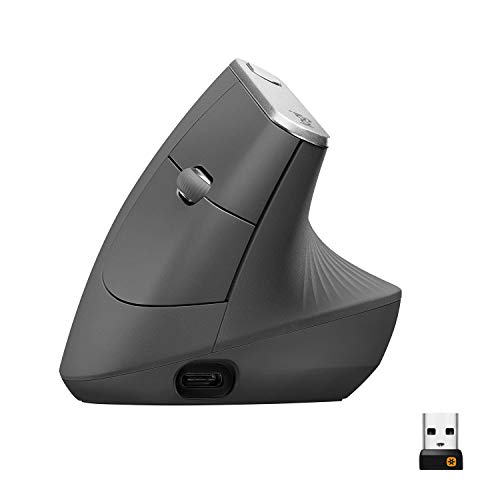
The MX Vertical is a genuinely good desk mouse — our wrist-comfort guide picks it for larger hands — and it is in this guide because a travel shortlist is where its file turns. Start with the bag: at 3.09 inches it is the tallest body we review, taller than the Lift that offers the same fixed 57-degree angle in a smaller, lighter, longer-lasting package, so a traveller choosing between the two verticals pays the packing cost twice for the same posture. Its rechargeable battery is rated up to four months with the same one-minute rescue, which is respectable — and still a cable to pack where the Lift needs none.
Two smaller details finish the case. Its review states plainly that the mouse has no storage compartment for its receiver, so the Unifying dongle travels loose — the exact failure the trackball's in-body storage exists to prevent. And owners of the tall, narrow-based shape report it is easy to knock over in the first weeks, catching it with a sleeve on a crowded desk; crowded, unfamiliar surfaces are the definition of travel work. None of this argues against the mouse at the desk it was built for, and our full review covers that case in full.
Fit check: if your hand genuinely needs the larger vertical and the Lift crowds it, the honest travel answer is to pack this one properly — pouch, cable, receiver kept with the laptop — rather than to switch shapes for a trip and relearn your pointing at the other end. Judge it as the exception that proves the checks, not as a mouse this guide is against.
When none of the four is the right buy
Left-handed travellers first, because the limit is total: every mouse in this guide is a right-hand body in the listing reviewed — the MX Master 3S and MX Vertical have no left-hand version, the trackball has no left version at all, and the Lift's left-hand version is a different listing from the Graphite one reviewed here. A left-handed reader should shop the left-hand listings directly rather than adapt a pick from this page. The same honesty applies at the small end: none of the four is a true mini or pocket mouse. If your travel kit is a tablet sleeve and nothing more, the product you want is a smaller category than anything we have reviewed, and this guide will not stretch a desk mouse into it.
The other honest case is the short trip with a good trackpad. If the work at the other end is email, documents and calls for two days, the best travel mouse may be the one you leave at home — every pick here earns its bag space on trips where pointing is the work: spreadsheets, design, operations, long editing sessions on unfamiliar desks. And if your travel problem is actually the whole setup rather than the mouse, our laptop stand guide for travel runs the same packing logic over the stands we review, while our small home office setup guide covers the compact end of the home desk these mice return to.
Travel mouse questions, answered honestly
What makes a mouse good for travel?
Three checks, in the order a trip tests them. Packed size and shape: the body has to ride in a bag without dominating it, which is about height as much as length — a tall vertical body packs worse than a longer flat one. Power you do not have to think about: a mouse that runs for months on a single AA battery cannot die mid-trip, while a rechargeable mouse trades that certainty for a cable and a quick-charge rescue. And the surface at the other end: hotel glass, a tray table and a café counter are not your desk, so the mouse has to point on what it finds — a sensor that tracks on glass, or a trackball that needs no surface run at all.
Which reviewed mouse is the smallest and lightest for a bag?
The Logitech Lift. At 4.25 by 2.76 inches and 4.4 ounces (125 g) it is the smallest and lightest of the four mice we review, and it also runs the longest between battery worries — up to 24 months on a single AA battery, so there is no charging cable to pack. Its trade is height: at 2.80 inches tall it is a vertical body, not a flat one, so it wants a pouch or a pocket of its own rather than sliding flat against a laptop. This listing is the right-hand Graphite version.
Is a trackball mouse worth it for travel?
For the right traveller, yes — it is the only reviewed design that removes the surface from the question. The Logitech ERGO M575S never moves, so a tray table, an armrest-width ledge or a crowded café table is enough; there is no mouse run to find. Its Logi Bolt receiver also stores inside the battery compartment, the one receiver-storage detail in our coverage. The trades are real: it is the largest body we review at 5.28 by 3.94 inches, the pointing work moves to your thumb, and a thumb trackball takes a learning week before it feels precise.
Which reviewed mouse works on a glass hotel desk?
The Logitech MX Master 3S. Its Darkfield sensor is recorded in its review as tracking on glass of 4 mm minimum thickness, which is exactly the surface hotels and modern offices keep choosing. The other three mice carry no such glass claim in their reviews, so this guide does not make one for them: on a glass desk they want a pad, a mat, a notebook — something between the sensor and the glass. If your trips reliably end at glass desks, that one specification decides the pick before size or battery enter it.
AA battery or rechargeable — which is better in a travel mouse?
They fail differently, which is the honest way to choose. The AA mice here — the Lift at up to 24 months and the ERGO M575S at up to 18 months on a single cell — effectively cannot run out mid-trip, and a spare AA is buyable almost anywhere; the cost is carrying that spare and getting no warning worth trusting. The rechargeable mice — the MX Master 3S at up to 70 days and the MX Vertical at up to four months — pack no spare but do pack a USB-C cable, and both rescue a dead battery fast: about three hours of use from a one-minute charge. Pick by which failure you would rather manage.
Bottom Line
Run the trip's three checks, then read the four mice in order
Name what your trips actually test — the bag space you can spare, the battery failure you would rather manage, and the surfaces waiting at the other end — and buy the mouse that wins your check. For most travellers that is the Logitech Lift: the smallest and lightest body we review, on a single AA battery rated up to 24 months, with the vertical posture you use at home kept on the road. Where there is no surface to mouse on, the Logitech ERGO M575S removes the question — stationary, flat, and the one receiver that stores in the body. Where the desk at the other end is glass, the MX Master 3S is the only reviewed sensor recorded as tracking on it. And let the MX Vertical stay the larger-hands desk pick it is, unless its size is the one your hand needs. For the desk-side comparison, see our mouse guide for working from home, or browse all our mouse reviews.