
Buying Guide — Ergonomic Chairs
Best Ergonomic Chair for Small Spaces
Every other chair guide on this site sorts by the sitter. A small room adds a second customer: the floor. The chair is the largest object most home offices add, it moves several times a day, and when you stop sitting in it, it has to park somewhere. This guide runs the four chairs we have reviewed through the three checks a small space changes — the published footprint, whether the arms let it tuck under the desk, and how it lives in the room between uses — and the smallest footprint here comes with flip-up arms, which turns out to matter more than the inches.
Affiliate disclosure: Home Office Stack is a participant in the Amazon Services LLC Associates Program. As an Amazon Associate, we earn from qualifying purchases made through links on this page — at no extra cost to you. Picks are research-based, grounded in manufacturer specs and published owner feedback; we don't accept sponsored placements.
Three checks decide a chair for a small space
First check: the published footprint — the floor rectangle you give up permanently. Overall width and depth are the only honest starting point, because they are the figures a maker publishes and a buyer can measure a room against. Read across the four chairs reviewed here and the spread is wider than the chairs' similar looks suggest: the smallest published footprint is 25.6 by 22 inches, the largest is 28.5 by 27 — roughly a third more floor rectangle for the biggest than for the smallest, in rooms where a third of a chair is often the difference between a walkway and an obstacle. One caution belongs on the check itself: a listing rectangle is the chair at rest, casters to back. It is not the working footprint, which is what the third check adds.
Second check: whether it tucks under the desk — the parked footprint. A chair spends most of its life unoccupied, and in a small room where it parks decides whether the room still works after hours. The blocker is almost never the seat; it is the arms, which meet the desktop or a drawer unit and stop the chair with its back and half its seat still out in the room. Arms that fold completely away remove the stop. Arms that only adjust in height lower the stop but keep it. So this check is close to binary, and it can outweigh a small footprint deficit: a slightly larger chair that parks under the desk can take less of the room, hour for hour, than a smaller one that parks in the doorway.
Third check: how it moves and stands in the room. A small-space chair is rolled in and out far more often than a chair in a spare room, because the same floor serves other purposes. Weight is part of it — though the four chairs here sit within a few pounds of each other, so it rarely decides — and so is what a chair asks of the space around it: how far it rolls back when you stand, how far a recline reaches, and how tall it stands visually against a small room's other furniture. None of these appear in a headline spec, which is why they are checked per chair below rather than assumed from the footprint. Body fit still matters, of course — it is simply a different question, and our chair guide for smaller users and chair guide for tall users split these same four chairs by the sitter's measurements instead of the room's.
The chairs we've reviewed, compared by small-space checks
| GABRYLLY Ergonomic Office Chair | The top pick for small rooms — smallest footprint, and the only arms that fold away | 25.6 × 22 in published footprint · flip-up arms fold up and back completely · mesh seat and back · 41 lb · overall height 45.3 to 54.9 in | Parks under the desk with arms folded · no adjustable lumbar — the support is the back's fixed curve · judge capacity against 280 lb, the lowest published figure |
| Duramont Ergonomic Office Chair | The runner-up on footprint — sized for larger frames | 26 × 23.6 in published footprint · 42 in overall height · rollerblade style casters · 44.5 lb, the heaviest here · rated to 330 lb | Arms adjust in height but do not fold away · fit is geared to taller and larger sitters · the low overall height keeps it visually compact |
| SIHOO M57 Ergonomic Office Chair | The adjustment pick — not ranked on footprint, because none is recorded | No overall footprint in the specs recorded in its review · seat depth 18.11 in · seat height from about 17.1 in · 41.6 lb · aluminum five-star base | Lumbar adjusts in height and depth, 3D arms, adjustable headrest · arms adjust but do not fold away · measure the listing's own size figures before ordering |
| HON Ignition 2.0 Mid Back Task Chair | The honest skip for the tightest rooms — the largest footprint here | 28.5 × 27 in published footprint · mid-back, no headrest on this model · 44.5 in overall height · 42 lb · rated to 300 lb | Roughly a third more floor rectangle than the smallest chair here · arms adjust in height and width but do not fold · its real case is adjustment and shared desks, not small rooms |
Specs above are as recorded in each product's full review on this site. One chair wins both size checks, one is disqualified by them despite being the only mid-back, and one cannot be ranked on size at all — which is itself a finding worth publishing.
The small-space pick: GABRYLLY Ergonomic Office Chair
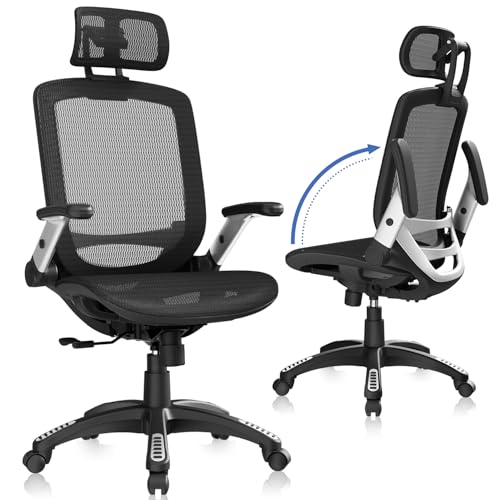
The GABRYLLY wins this guide on both size checks at once, which no other chair here manages. On footprint, its published 25.6 by 22 inches is the smallest rectangle of the four — the floor you give up permanently is the least on offer. On parking, it is the only chair here whose arms leave the problem entirely: they flip up and back completely out of the way, so at the end of the day the chair pushes under the desk until the seat is beneath the top, and the room gets its floor back. In a room that doubles as something else after work — a bedroom, a living room corner, a nursery-to-be — that parked position is worth more than another inch of seat adjustment.
The chair inside those dimensions is a full-mesh design: mesh seat as well as mesh back, which testers found soft and springy on both surfaces, on a five-point nylon base with PU mute wheels, at 41 pounds — the lightest here, a small mercy in a chair that will be moved often. Its seat is 20 inches wide measured, so the small footprint is not bought with a narrow seat; it is bought with a shorter depth and arms that disappear.
The honest costs are real, and two of them are fit costs rather than size costs. There is no adjustable lumbar support: what the listing calls lumbar support is the fixed curve of the mesh back, and testing records adjustable lumbar as absent, full stop. The adjustable 3D headrest suited taller sitters in testing — testers under 5 feet 4 inches could not reach it at its lowest setting — and the seat height range, measured at 17.5 to 22 inches, starts high for smaller sitters. And where the maker's figures disagree on capacity, this site judges against the lowest published figure, 280 pounds. None of that changes the room verdict; it decides which sitters the room verdict applies to.
Fit check: buy it when the room is the constraint — a desk in a bedroom or living space, a chair that must park out of the way — and the fixed lumbar curve and taller-sitter headrest fit the person who will sit in it. Our full review records the details behind this section.
Second-smallest footprint, sized for larger frames: Duramont

The Duramont's published footprint, 26 by 23.6 inches, is close enough to the GABRYLLY's that in many rooms either would fit the same corner — and its 42 inch overall height is the lowest here, so it stands visually smaller than its rectangle suggests. Its rollerblade-style casters are the free-rolling kind, which cuts both ways in a tight room: the chair moves in and out with little effort, and it can also drift on a hard floor when bumped. At 44.5 pounds it is the heaviest chair in this guide, though the casters mean the weight is rarely lifted, only rolled.
Where it loses this guide is the second check. Its armrests adjust in height, and fore-aft only by loosening screws — a workshop adjustment, not a parking one — so the arms stay present, and the chair parks the way most chairs park: in until the arms meet the desk, with the back still in the room. In a dedicated small office that may cost nothing. In a room with a second job, it is the difference between the GABRYLLY's full tuck and a permanent chair-shaped share of the floor.
The deeper point is who the chair is for. Its fit is geared to larger individuals: a high back with a 21.25 inch interior height, an integrated headrest, a deeper seat, and a 330 pound rating — in hands-on testing the taller testers were the happy ones, and shorter testers struggled with the seat depth, with no seat-depth adjustment to fix it. So this is the small-space answer for a specific overlap: a larger sitter in a smaller room, where the chair must be compact on the floor and generous in the seat at the same time. That overlap is real, and this is the only chair here that serves it.
Fit check: buy it when the sitter is taller or larger-framed, the room is small but dedicated, and a chair that parks partway out is an acceptable price for the fit. Our full review records the details behind this section.
The adjustment pick, unranked on size: SIHOO M57

The SIHOO M57 section starts with an absence, stated plainly: the specs recorded in its review on this site do not include an overall width and depth, so this guide does not rank it on footprint and does not guess one. A small-space guide that invented the one figure its whole subject turns on would not be worth reading. What is recorded is still useful: an 18.11 inch seat depth — shallower than the GABRYLLY's measured seat — a seat height starting at about 17.1 inches, a 41.6 pound weight, and a reinforced aluminum five-star base with smooth-rolling, quiet casters.
On the parking check it sits with the majority: its 3D armrests adjust in height, fore-aft and angle, but they do not fold away, so it parks against its arms like the Duramont and the HON. What it offers instead is the longest honest adjustment story for the sitter: a full-mesh seat and split back, lumbar support that adjusts in both height and depth — the only chair here that moves in both directions — an adjustable headrest, and a fit that reviewers consistently describe as suiting small-to-average frames better than its big-and-tall marketing claims.
So the M57's small-space case is conditional, and the condition is a tape measure. If its adjustment list is the one your body needs, take the overall dimensions from the listing you would actually order from — variants differ, and this site does not substitute one variant's figures for another's — and run the parked and rolled-back checks from the top of this guide against your room. If those numbers fit, its size is no worse than unproven; if they do not, no lumbar mechanism makes a chair smaller.
Fit check: buy it when adjustment — especially lumbar that moves in height and depth — outranks a verified footprint, and only after measuring the listing's own overall dimensions against your room. Our full review records the details behind this section.
The honest skip for the tightest rooms: HON Ignition 2.0

The HON is the guide's standing warning against shopping by silhouette. It is the only mid-back here, the only chair with no headrest in this configuration, and at 44.5 inches overall it stands lower than the GABRYLLY — by every visual cue, the compact one. Its published footprint says otherwise: 28.5 by 27 inches, the widest and deepest of the four, roughly a third more floor rectangle than the smallest chair in this guide. In a room where floor is the scarce resource, the tape measure outranks the silhouette, and the tape measure disqualifies it first.
It does not recover on the parking check either. Its armrests adjust in height and width — genuinely useful adjustments — but they do not fold away, so the parked chair stops at its arms like the Duramont and the SIHOO, on top of the largest footprint. A big chair that also parks big is the combination a small room can least afford.
None of this makes it a bad chair; it makes it a chair for a different problem. Its adjustment list is the longest in our chair reviews — a seat-depth slide none of the others offer, a lumbar panel that moves to almost any height, synchro-tilt — and its natural home is a desk shared by differently sized sitters, in a room with floor to spare. Our lumbar support guide and the general ergonomic chair guide make that case in full. For the tightest rooms, skip it, and let its absence be the guide's most useful sentence.
Fit check: skip it when floor space is the deciding constraint — its footprint is the largest here and its arms do not fold. Consider it when adjustment and a shared desk matter more than the room, as our full review sets out.
When the room, not the chair, is the problem
Sometimes the honest conclusion of the three checks is that no full ergonomic chair fits the room as it stands — the rolled-back position blocks the door for every candidate, or the parked chair takes the only floor the room has left. That is a layout problem before it is a shopping problem. The levers that actually change it are the desk's size and position, not a fourth chair: a smaller top, a desk turned against a different wall, or a standing desk whose footprint was chosen for the room in the first place. Our small home office setup guide works through that layout order, and our standing desks for small spaces guide applies the same footprint-first reading to the desks themselves.
And one boundary is worth keeping: a small room never makes body fit optional. A compact chair whose seat starts too high or runs too deep for the person in it will be abandoned for the sofa within a month, and an abandoned chair takes more room than any of these. Run the room checks in this guide to shortlist, then run the sitter checks — lowest seat height, seat depth, lumbar reach — in our smaller users guide or tall users guide before ordering. The right answer is the chair that passes both sets.
Small-space chair questions, answered honestly
Which of these chairs has the smallest footprint?
The GABRYLLY Ergonomic Office Chair, on the figures recorded in its review: 25.6 inches wide by 22 inches deep. The Duramont is next at 26 by 23.6 inches. The HON Ignition 2.0 is the largest of the four at 28.5 by 27 inches — roughly a third more floor rectangle than the GABRYLLY. The SIHOO M57 publishes no overall footprint in the specs recorded in its review, so this guide does not rank it on size; what is recorded for it is an 18.11 inch seat depth and a 41.6 pound weight.
Why do flip-up arms matter in a small room?
Because they decide where the chair lives when you are not sitting in it. Arms are usually the part that stops a chair partway under a desk: the seat slides in and the arms hit the desktop or the drawer unit, leaving the back and half the seat out in the room. The GABRYLLY's arms fold up and back completely out of the way, so the chair pushes in until the seat is under the top and the parked footprint shrinks to roughly the desk's own depth. The other three chairs' arms adjust in height — and the HON's in width — but none of them folds away, so each parks with its arms as the stop.
How much room should I allow beyond a chair's published footprint?
More than the rectangle on the listing, in two directions. Behind the desk, the chair rolls back every time you get up, and a reclined back reaches further still, so the working footprint is the published depth plus your roll-back. In front, a chair that cannot tuck under the desk parks in the walkway instead. Measure both parked positions before you buy: pushed fully in, and rolled back with you standing up from it. If the second position blocks a door, a drawer or the only path through the room, the chair is too big for the room whatever its listing dimensions say.
Is a mid-back chair automatically the small-room choice?
No — the HON Ignition 2.0 is the counterexample in this guide. It is the only mid-back here and it has no headrest in this configuration, yet its published footprint, 28.5 by 27 inches, is the largest of the four chairs, wider and deeper than both high-backs with published figures. Back height changes how tall a chair looks and how it supports you; it does not reliably change the floor it takes. Judge a small-space chair by its published width and depth and by whether its arms fold, not by the height of its back.
What if the chair I like does not publish a footprint?
Treat the missing figure as a check to run, not a gap to guess across. That is the SIHOO M57's position in this guide: its review records an 18.11 inch seat depth, a seat height starting at about 17.1 inches, a 41.6 pound weight and full adjustment, but no overall width and depth, so it is not ranked on footprint here. If it is your candidate, take the overall dimensions from the listing you would actually order from, and run the same parked-and-rolled-back measurement against them before buying — a chair that cannot be measured cannot be promised to fit.
Bottom Line
Measure the room first — then let the arms decide
Start with the tape measure, not the catalogue. On published footprint the GABRYLLY is the smallest chair here at 25.6 by 22 inches, and its flip-up arms make it the only one that parks fully under the desk — the small-space pick on both counts. The Duramont is the close second on footprint for larger sitters who need the bigger seat. The SIHOO M57 is the adjustment pick whose footprint you must take from its listing and measure yourself, because its recorded specs do not publish one. The HON Ignition 2.0 is the honest skip for tight rooms — a mid-back with the largest footprint here. Choosing by the sitter instead? See our chair guide for long hours, or browse all our ergonomic chair reviews.