
Buying Guide — Ergonomic Chairs
Best Ergonomic Chair for Heavier Users
Most chair advice is written as if weight were a footnote. For a heavier sitter it is the headline: it decides which chairs are candidates at all, it is the load the seat surface has to carry for years, and it exposes the gap between a chair that is rated for your weight and a chair that actually fits your frame. This guide runs the four chairs we have reviewed through the three checks weight changes — the published rating, read conservatively; the seat under load, foam against mesh; and the frame the rating sits on — and the honest headline is that the two 330 lb chairs here are built for two different bodies.
Affiliate disclosure: Home Office Stack is a participant in the Amazon Services LLC Associates Program. As an Amazon Associate, we earn from qualifying purchases made through links on this page — at no extra cost to you. Picks are research-based, grounded in manufacturer specs and published owner feedback; we don't accept sponsored placements.
Three checks decide a chair for a heavier sitter
First check: the published rating — read conservatively, and bought with headroom. The weight rating is the gate: a chair rated below your weight is not a candidate, whatever its adjustment list says. Two disciplines apply to the number itself. Where a maker's own published figures conflict, the lowest one governs — one chair in this guide is listed at 280, 300 and 400 lb in three different places, and this site judges it at 280. And a rating is a ceiling, not a target: it is the load the chair is built to carry, tested under the maker's conditions, not a promise about a full work week sat at the limit for years. Judge candidates against the rating with clear headroom under it.
Second check: the seat under load — what you sit on, and for how long it stays itself. A heavier sitter compresses a seat harder and longer, so the seat's material is a durability question before it is a comfort one. The two surfaces in this guide age differently on the record in their reviews. Foam can flatten within a single long sit and, on one chair here, owner reporting describes it compressing permanently over two to three years under heavier sitters. Mesh carries its record the other way: owners of the mesh chairs here report seats holding their shape over months, and one is described in owner-feedback roundups as a seat that does not bottom out. Neither surface is free: foam starts softer, mesh starts taut and needs a break-in week.
Third check: the frame the rating sits on — capacity is not fit. A rating certifies the structure; it says nothing about whether the seat is wide or deep enough, whether the back reaches, or whether the armrests land where your arms are. This guide's sharpest example: two chairs share the same 330 lb rating, and one is geared to larger frames while reviewers consistently place the other on small-to-average frames despite its big-and-tall marketing. The base under the seat belongs in this check too — one of the 330 lb chairs stands on a reinforced aluminum base, another chair here on a five-point nylon one — because the base is part of what the rating is actually standing on. Height and room are different questions again, answered by our chair guide for tall users and chair guide for small spaces over these same four chairs.
The chairs we've reviewed, compared by the weight checks
| Duramont Ergonomic Office Chair | The heavier-users pick — the rating and the frame agree | Rated to 330 lb · fit geared to larger frames · high back, 21.25 in back interior height · thick foam cushion · rollerblade-style casters · 44.5 lb | Owners consistently call the build sturdy · comfort tops out at part to most of a day in independent testing · firm cushion softens with use; occasional squeaks reported |
| SIHOO M57 Ergonomic Office Chair | The conditional 330 — a real rating on a smaller frame | Rated to 330 lb · reinforced aluminum five-star base · full-mesh seat, 18.11 in seat depth · lumbar adjusts in height and depth · 41.6 lb | Owners report the mesh holding its shape over months · reviewers place the fit on small-to-average frames despite the big-and-tall listing language · mesh starts taut, about a week to settle |
| HON Ignition 2.0 Mid Back Task Chair | The long-keep conditional — 300 lb behind a lifetime warranty | Rated to 300 lb · limited lifetime warranty · seat width 20 in · seat-depth slide, 16.25 to 19.25 in · contoured foam seat · 42 lb | Foam flattens on prolonged sits in testing, and owner reporting describes it compressing over two to three years for heavier sitters · comfortable window about six hours |
| GABRYLLY Ergonomic Office Chair | The honest skip at this guide's line — a wide seat its rating cannot back | Judged against 280 lb, the lowest of its conflicting published figures · mesh seat 20 in wide measured · five-point nylon base · seat height 17.5 to 22 in measured · 41 lb | Owner-feedback roundups describe a seat that does not bottom out — but the rating conflict (280 / 300 / 400 lb) means the conservative figure governs, and no adjustable lumbar |
Specs above are as recorded in each product's full review on this site. Read the table in this guide's order: the rating gates, the seat surface argues, and the frame decides between the two chairs that share the top rating.
The heavier-users pick: Duramont Ergonomic Office Chair

The Duramont is the one chair in this guide where all three checks point the same way. On the rating, it is built to 330 lb — the top figure in our coverage — with no conflicting figure in its record to discount. On the frame, it is geared to larger individuals in a way the others are not: a high back with a 21.25 inch interior height and an integrated headrest, a deeper seat, and dimensions of 26 by 23.6 inches. In independent hands-on testing, the taller and larger testers were the happy ones — they liked the deeper seat and the full backrest, and most had no issues using it for a full workday — and owners on the listing consistently call the build sturdy and well-made. When you sit back in it properly, testers found the whole back supported.
Its seat is the foam entry in this guide, and its record is the better foam story of the two. Owners flag a firm cushion that softens with use — the opposite trajectory from a seat that gives out — and the adjustment list behind it is longer than most at its level: lumbar support that moves up, down, in and out, a tilt tension knob with a wide range, and a tilt limiter for the recline. The rollerblade-style casters are worth a heavier sitter's attention for a plain reason: the chair rolls instead of dragging, at 44.5 lb the heaviest chair here.
The limits are real and they are about duration and detail, not capacity. Independent testing caps its comfort at part of a day to a moderate day rather than a full eight-plus hours — its bottom line in our review is four to five hours — and rates it a decent chair rather than a premium substitute. The lumbar moves only a small range, the headrest divided testers, the armrests move fore-aft only by loosening screws for about an inch, and owners report occasional squeaks. None of that is a weight failure; it is the honest price of the pick, stated so the rating does not oversell the chair.
Fit check: buy it when you want the highest rating in our coverage on the frame actually built for a larger sitter, and your sitting day is part-to-moderate or broken into sessions. Our full review records the details behind this section.
The conditional 330: SIHOO M57

The SIHOO M57 passes the first check as cleanly as the Duramont does. Its 330 lb rating is corroborated — Amazon's product information for this listing and the maker's own current spec page agree on it — and the structure under it is the strongest-sounding in the guide: a reinforced aluminum five-star base, where the GABRYLLY stands on nylon. On the second check it is arguably the best seat here for a heavier sitter who fits it: a full-mesh seat that owners report holding its shape over months rather than sagging, with a waterfall front edge reviewers credit for leg comfort through long stretches, and no foam anywhere to flatten or compress.
The condition is the third check, and it is not a small one. The listing language calls this chair big and tall; the reviewer record says the opposite. Reviewers who seat panels for a living consistently conclude it fits small-to-average frames best — sitters around six feet and up regularly find the headrest and armrests running out of range right where they need them, and a 5 ft 10 in owner found the headrest could not go high enough. Its recorded seat depth is 18.11 inches with no seat-depth adjustment. Weight and frame size travel together often, but not always: a heavier sitter of average or smaller build is a different case from a heavier, larger-framed one, and this chair serves the first, not the second.
What the fitting sitter gets is the longest adjustment list in our chair coverage: lumbar support that moves in both height and depth — the only chair here that travels in both directions — an adjustable headrest with about 3.15 inches of travel, 3D armrests, and a three-position recline lock between 90 and 126 degrees, on a three-year warranty with free replacement parts. The mesh starts taut and needs about a week of sitting before it settles, and the lumbar can feel forward-pushy until its depth is dialled back — judge it after the break-in, not on day one.
Fit check: buy it when you are heavier but average-or-smaller framed, and you want the 330 lb rating with the mesh seat and the two-direction lumbar. If you are larger-framed as well as heavier, the Duramont above is the same rating on your frame. Our full review records the details behind this section.
The long-keep conditional: HON Ignition 2.0

The HON's case for a heavier sitter is not its rating — 300 lb, a step below the two leaders — it is what stands behind the rating. This is a contract-office chair from a manufacturer that sells the line into workplaces by the floor, backed by a limited lifetime warranty, and its review's verdict is that the warranty and contract parts support are the actual product: the deliberate buy for anyone who keeps furniture for a decade. For a heavier sitter, whose chair works harder than average, a maker who will still sell you parts in year eight is a weight-relevant fact, not a footnote.
Its fit tools are also the best here for dialling a chair to a body: six measured points of adjustment in testing, the strongest adjustability score of the four, a seat-depth slide from 16.25 to 19.25 inches that none of the others offer, a 20 inch seat width, and a lumbar panel that moves to almost any height and — in Wirecutter's testing, which names it their best budget office chair — stays where it is put. It is also the fastest assembly here, at eight minutes in testing.
The second check is where it pays. Its contoured foam seat starts squishy and supportive but flattens on prolonged sits in testing, and longer-horizon owner reporting adds the slower version of the same story: seat foam compressing over two to three years for heavier sitters. Testing caps its comfortable window at about six hours, and the lumbar panel that adjusts so well is thin, unpadded plastic against your back. So the HON's honest shape for this guide is: the best-supported 300 lb chair, with the seat surface most likely to be the first thing a heavier sitter wears out — and a warranty culture best placed to answer that when it happens.
Fit check: buy it when you sit at or comfortably under 300 lb, sit in blocks rather than full days, and value the decade-long keep — parts, warranty, re-fitting a different sitter in seconds — over the highest rating. Our full review records the details behind this section.
The honest skip at this guide's line: GABRYLLY
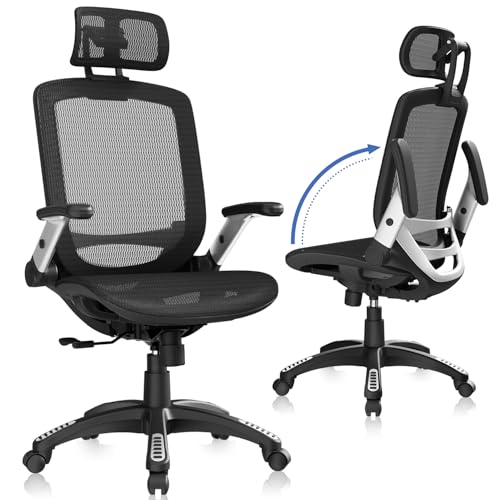
The GABRYLLY is in this guide to demonstrate the first check, because on the second and third it makes a genuine case. Its mesh seat is 20 inches wide as measured in testing — as wide as any seat here — testers found the mesh soft and springy on seat and back alike, three of the testing panel said they could sit in it for at least seven hours, and roundups of its owner feedback describe mesh that stays tight, a back that does not sag, and a seat that does not bottom out. For a sitter under its line, that is exactly the seat record a heavier reader is shopping for, and our general chair guide makes its wider case.
The rating stops it. This one chair is published at three different capacities: 280 lb in independent testing's spec table, 300 lb in Amazon's product information for the listing, and 400 lb in some listing copy. Those cannot all be the tested figure, and a weight rating is the one number a buyer cannot verify at home and cannot afford to have rounded in the maker's favour. This site's rule — stated in the chair's own review — is that the lowest published figure governs: judge this chair against 280 lb. Bought with the headroom the first check requires, that puts its honest ceiling below 280, under both rivals' ratings, on a five-point nylon base.
Add the fit facts and the skip completes itself for most heavier readers: there is no adjustable lumbar support at all — the support is the fixed curve of the mesh back — the armrests adjust for height only, and the chair sits high, with a measured seat range of 17.5 to 22 inches that suits taller sitters. A wide, durable-feeling seat is a real virtue; it is not a substitute for a rating you can trust at your weight.
Fit check: skip it if you are at or near 280 lb — on the conservative figure that governs here, you would be buying at the ceiling. Below that line with clear headroom, its wide mesh seat is a legitimate pick, as our full review sets out.
When none of these four is the answer
This guide's coverage ends at 330 lb, and it is better to say so than to stretch it. If you weigh more than that — or close enough to it that the headroom rule leaves no candidate — none of the four chairs reviewed on this site is an honest recommendation, and no wording in a guide like this one should talk you into buying at a rating's edge. The category beyond this coverage exists (chairs built and rated specifically for higher capacities), but we have not reviewed one, so no brand is named here.
Shop that category by the same three checks. One consistent published rating, comfortably above your weight, from a maker who does not print three different figures in three different places. A metal base named in the specs, and a published seat width — a number you can measure your own chair against today. And a written warranty with replacement parts behind it, because at higher loads the parts question is a when, not an if. When a chair meeting those checks is reviewed on this site, it will be added to this guide; until then, the criteria are the help we can honestly give. Weight is also rarely the only fit axis: if height is the other half of your fit problem, our tall users guide splits these same chairs by reach, and the long hours guide splits them by tested comfortable window.
Heavier-user chair questions, answered honestly
What weight are the chairs in this guide rated to?
Two of the four are rated to 330 lb: the Duramont Ergonomic Office Chair and the SIHOO M57, whose Amazon product information and maker's spec page agree on that figure. The HON Ignition 2.0 is rated to 300 lb. The GABRYLLY is the exception: its published figures conflict — 280 lb in independent testing's spec table, 300 lb in Amazon's product information, 400 lb in some listing copy — so this site judges it against the lowest published figure, 280 lb, and this guide treats it as the skip at and above that line.
Why does this guide use 280 lb for the GABRYLLY when its listing says more?
Because the figures for that one chair disagree with each other, and a weight rating is the one number in a chair listing that should never be rounded in the maker's favour. Independent hands-on testing records 280 lb in its spec table for this chair; Amazon's product information for the same listing says 300 lb; some listing copy says 400 lb. Where a maker's own numbers conflict, this site publishes and judges against the lowest one. If the maker confirms a single higher figure, the review will be corrected at the source.
Does a high weight rating mean a chair fits a larger person?
No — capacity and fit are different checks, and this guide's clearest example is the SIHOO M57. It is rated to 330 lb on a reinforced aluminum base, yet reviewers who seat panels for a living consistently report that it fits small-to-average frames best: sitters around six feet and up find the headrest and armrests running out of range. The Duramont carries the same 330 lb rating on a frame geared to larger sitters — a deeper seat and a taller back. A rating tells you what the chair is built to carry; the frame's dimensions tell you whether it carries you comfortably.
Foam or mesh seat — which holds up better for a heavier sitter?
On the evidence recorded in these reviews, mesh has the longer story. Owners of the SIHOO M57 report its mesh holding its shape over months rather than sagging, and roundups of the GABRYLLY's owner feedback describe a seat that does not bottom out. Foam's record here is shorter: the HON's high-density foam seat flattens on prolonged sits in testing, and longer-horizon owner reporting describes its seat foam compressing over two to three years for heavier sitters. The Duramont's foam cushion is the partial exception — owners call it firm at first and report it softening with use. Mesh's own caveat is feel, not durability: it starts taut and needs about a week of sitting to settle.
What if I weigh more than 330 lb?
Then none of the four chairs reviewed on this site is the honest answer: 330 lb is the highest rating in our coverage, and a rating should be bought with headroom under it, not at it. Shop the criteria instead — a single, consistent published rating comfortably above your weight, a metal base, a published seat width, and a maker who sells replacement parts and stands behind a written warranty. No chair is recommended here for that case, because none we have reviewed meets it, and stretching a 330 lb rating past its line is exactly the purchase this guide exists to prevent.
Bottom Line
Let the rating gate, the seat argue, and the frame decide
Start with the ceiling, read conservatively. The Duramont is the heavier-users pick: a 330 lb rating on the one frame here geared to larger sitters, with owners who call the build sturdy. The SIHOO M57 carries the same 330 lb on an aluminum base with a shape-holding mesh seat — the conditional pick for a heavier sitter of average-or-smaller frame. The HON Ignition 2.0 is the 300 lb long keep, lifetime warranty first, foam seat caveat stated. The GABRYLLY is the skip at this guide's line — a wide mesh seat judged against 280 lb, the lowest of its conflicting figures. Above 330 lb, our coverage honestly ends and the criteria in this guide are the shopping list. Choosing by a different axis? See our chair guide for lumbar support, or browse all our ergonomic chair reviews.